Wednesday, March 21, 2007
Media Life Magazine
Media Life Magazine: U.S. Hispanics wield an increasing amount of spending power and have become a desirable group to advertisers, but one area where they continue to lag is the internet. A smaller percentage of Latinos go online than any other ethnic group, according to a new report from the Pew Internet & American Life Project. The study finds that only 56 percent of U.S. adult Latinos go online, compared with 60 percent of blacks and 71 percent of whites. They are especially far behind in broadband connections, with 29 percent of Latinos using high speed compared with 43 percent of whites. At the same time, there are major differences between different Hispanic demographic groups. Nearly 80 percent of English-speaking Latinos and 76 percent of bilingual Latinos use the web compared with just 29 percent of Spanish-dominant Latinos. Education and economic factors appear to be the biggest indicator of who’s going online. Susannah Fox, associate director of the Pew Internet & American Life Project and co-author of the report, talks to Media Life about why so many immigrants are not online, what role education plays, and why Mexicans have lower web usage.


National Women's History Project

National Women's History Project: The National Women's History Project, founded in 1980, is an educational nonprofit organization. Our mission is to recognize and celebrate the diverse and historic accomplishments of women by providing information and educational materials and programs.
March is National Women's History Month!
Women's History Month 2007 -- A National Register of Historic Places Feature

Women's History Month 2007 -- A National Register of Historic Places Feature: The National Register of Historic Places is pleased to promote awareness of and appreciation for the historical accomplishments of American women during Women's History Month. As part of the celebration, this site showcases historic properties listed in the National Register, National Register publications, and National Park units commemorating the events and people, the designs and achievements that help illustrate the contribution of women to the Nation's history. Join the National Register in paying tribute to the many women who have made an impact in our past.
Accelerating Hispanic Progress in Higher Education
Accelerating Hispanic Progress in Higher Education
As the Hispanic community continues to grow in this country, efforts to accelerate and expand student success in higher education will be critical to the nation’s future competitiveness, says Excelencia in Education President Sarita Brown at a Capitol Hill policy briefing on Tuesday.
Excelencia, a nonprofit organization aimed at increasing Hispanic student achievement in higher education, also released figures on the state of Hispanics in higher education and a separate study concerning Hispanic women in the science, technology, engineering and mathematics programs.
There were approximately 1.8 million Hispanic college students in 2004, representing about 11 percent of the total student enrollment in higher education. The figure represents a 6 percent increase from 1990, when 782,400 Hispanic students were enrolled. But despite increases in enrollment, only 25 percent of college-age Hispanics — those 18 to 24 years old — were enrolled in college, compared to about 42 percent of Whites, 32 percent of Blacks and 60 percent of Asians.
“The number of Hispanic women going to college has increased more rapidly. In 2004, Hispanic women represented almost 60 percent of all Hispanics in higher education,” said Deborah Santiago, vice president for policy and research at Excelencia. She noted that about 58 percent of Hispanic undergraduates are enrolled in two-year institutions.
But while Hispanic women enroll in college in greater numbers than Hispanic men, men greatly outnumber women in engineering programs. In 2005, undergraduate Hispanic women represented just 22 percent of Hispanics in engineering programs.
As the Hispanic community continues to grow in this country, efforts to accelerate and expand student success in higher education will be critical to the nation’s future competitiveness, says Excelencia in Education President Sarita Brown at a Capitol Hill policy briefing on Tuesday.
Excelencia, a nonprofit organization aimed at increasing Hispanic student achievement in higher education, also released figures on the state of Hispanics in higher education and a separate study concerning Hispanic women in the science, technology, engineering and mathematics programs.
There were approximately 1.8 million Hispanic college students in 2004, representing about 11 percent of the total student enrollment in higher education. The figure represents a 6 percent increase from 1990, when 782,400 Hispanic students were enrolled. But despite increases in enrollment, only 25 percent of college-age Hispanics — those 18 to 24 years old — were enrolled in college, compared to about 42 percent of Whites, 32 percent of Blacks and 60 percent of Asians.
“The number of Hispanic women going to college has increased more rapidly. In 2004, Hispanic women represented almost 60 percent of all Hispanics in higher education,” said Deborah Santiago, vice president for policy and research at Excelencia. She noted that about 58 percent of Hispanic undergraduates are enrolled in two-year institutions.
But while Hispanic women enroll in college in greater numbers than Hispanic men, men greatly outnumber women in engineering programs. In 2005, undergraduate Hispanic women represented just 22 percent of Hispanics in engineering programs.
Monday, March 19, 2007
American Indians in Oklahoma say English-only Policy Diminishes Their Tribal Languages
American Indians in Oklahoma say English-only Policy Diminishes Their Tribal Languages
OKLAHOMA CITY
Legislation to make English the official language of the state of Oklahoma has run into opposition from American Indians, who say their native tongues are dying fast enough without any help from lawmakers.
As Oklahoma observes its centennial year, the English-only issue bring up divisions that persist more than a century after American Indians were forcibly marched to the region and then endured a series of land grabs.
Many of Oklahoma’s 37 federally recognized tribes are fighting to save their languages and cultures from extinction years after the end of organized efforts to stamp them out.
Critics of the English-only legislation point out that Oklahoma’s very name is formed from two Choctaw Indian words — “okla” and “homma” — that mean “red man.”
“If you go to English only, what are we going to call the state of Oklahoma?” asks Terry Ragan, director of the Choctaw Nation’s language program. “Even town names in the state will have to be named differently.”
Supporters of the legislation say it could end bilingual state government documents, such as driver’s license tests, and force immigrants to learn English and assimilate into American society.
OKLAHOMA CITY
Legislation to make English the official language of the state of Oklahoma has run into opposition from American Indians, who say their native tongues are dying fast enough without any help from lawmakers.
As Oklahoma observes its centennial year, the English-only issue bring up divisions that persist more than a century after American Indians were forcibly marched to the region and then endured a series of land grabs.
Many of Oklahoma’s 37 federally recognized tribes are fighting to save their languages and cultures from extinction years after the end of organized efforts to stamp them out.
Critics of the English-only legislation point out that Oklahoma’s very name is formed from two Choctaw Indian words — “okla” and “homma” — that mean “red man.”
“If you go to English only, what are we going to call the state of Oklahoma?” asks Terry Ragan, director of the Choctaw Nation’s language program. “Even town names in the state will have to be named differently.”
Supporters of the legislation say it could end bilingual state government documents, such as driver’s license tests, and force immigrants to learn English and assimilate into American society.
Wednesday, March 14, 2007
Illinois Retires American Indian Mascot
Illinois Retires American Indian Mascot: The University of Illinois swept aside the last vestiges of Chief Illiniwek on Tuesday, voting to retire the mascot’s name, regalia and image.
The school will continue to call its sports teams the Fighting Illini under the resolution. Chancellor Richard Herman is to decide how and when Chief Illiniwek’s name and image will stop being used and licensed to apparel makers and others.
Activists and some American Indians have long complained the chief is demeaning. Backers defend him as an honorable tradition.
The school decided in February to end performances of the chief, leading the NCAA to lift sanctions that had barred Illinois from hosting postseason sports since 2005. The NCAA had deemed Illiniwek portrayed since 1926 by buckskin-clad students who danced at home football and basketball games and other sports events an offensive use of American Indian imagery.
The school will continue to call its sports teams the Fighting Illini under the resolution. Chancellor Richard Herman is to decide how and when Chief Illiniwek’s name and image will stop being used and licensed to apparel makers and others.
Activists and some American Indians have long complained the chief is demeaning. Backers defend him as an honorable tradition.
The school decided in February to end performances of the chief, leading the NCAA to lift sanctions that had barred Illinois from hosting postseason sports since 2005. The NCAA had deemed Illiniwek portrayed since 1926 by buckskin-clad students who danced at home football and basketball games and other sports events an offensive use of American Indian imagery.
Pew: Latinos less likely to be online - Tech News & Reviews - MSNBC.com
Pew: Latinos less likely to be online - Tech News & Reviews - MSNBC.com: Latinos are not going online as much as non-Hispanic whites and blacks, even at younger ages where Internet use is far greater, according to a report released Wednesday.
Fifty-six percent of adult Latinos use the Internet, compared with 70 percent of whites and about 60 percent of blacks, according to the Pew Hispanic Center and the Pew Internet & American Life Project.
The Internet use of U.S.-born Latinos is comparable to that of whites, but about two-thirds of adult Latinos in the United States were born elsewhere.
Fifty-six percent of adult Latinos use the Internet, compared with 70 percent of whites and about 60 percent of blacks, according to the Pew Hispanic Center and the Pew Internet & American Life Project.
The Internet use of U.S.-born Latinos is comparable to that of whites, but about two-thirds of adult Latinos in the United States were born elsewhere.
States stress benefits of pre-kindergarten programs

... A report being released Wednesday finds states spent at least $3.3 billion last year on pre-kindergarten. That doesn't include money from federal and local governments, which contribute to the state programs. The state funding is up from $2.8 billion in 2005, according to the report by the National Institute for Early Education Research at New Jersey's Rutgers University.
In all, nearly 1 million children, or 20 percent of the country's 4-year-olds, were in state pre-kindergarten last year -- up from 17 percent the previous year, the report found.
About two-thirds of 4-year-olds are in private preschool or child-care programs or at home, the study said.
About one in 10 is in Head Start, the federal pre-kindergarten program for poor children, the report said. The $6.8 billion Head Start program covers only about half of all eligible children. About 7 percent of the nation's 3-year-olds also participate in Head Start.
As in Virginia, most state-funded programs are aimed at poor children. However, Florida, Georgia and Oklahoma offer pre-k to all 4-year-olds. Other states are considering going that route.
Illinois Democratic Gov. Rod Blagojevich won approval to extend preschool to all 3- and 4-year-olds by 2011 and is pushing for the money to do it.
The federal No Child Left Behind education law probably has something to do with the trend, says Steven Barnett, who wrote the report on state pre-k spending.
One of that law's goals is to eliminate achievement gaps between low-income and wealthier students, but studies show the gap begins before children enter school.
Friday, March 09, 2007
HIV hits U.S. blacks harder than whites - AIDS - MSNBC.com
HIV hits U.S. blacks harder than whites - AIDS - MSNBC.com: ATLANTA - African American men are nearly seven times more likely to be diagnosed with HIV than white men, according to a report by the U.S. Centers for Disease Control and Prevention released on Thursday.
Blacks represent 13 percent of the U.S. population but account for nearly half of Americans living with the disease and 40 percent of AIDS deaths and 61 percent of all new diagnoses of people aged 13-24 are black.
The report, which is based on 2001-2005 data, does not reveal a dramatic increase in the rate of HIV infection among African Americans and it shows a significant decline in black mother-to-child transmission of HIV.
Blacks represent 13 percent of the U.S. population but account for nearly half of Americans living with the disease and 40 percent of AIDS deaths and 61 percent of all new diagnoses of people aged 13-24 are black.
The report, which is based on 2001-2005 data, does not reveal a dramatic increase in the rate of HIV infection among African Americans and it shows a significant decline in black mother-to-child transmission of HIV.
Thursday, March 08, 2007
Disney first: black princess in animated film - Movies - MSNBC.com

Disney first: Black princess in animated film - Movies - MSNBC.com: The Walt Disney Co. has started production on an animated musical fairy tale called “The Frog Princess,” which will be set in New Orleans and feature the Walt Disney Studio’s first black princess.
The film, set for release in 2009, also is the first hand-drawn film Disney has committed to since pledging last month to return to the traditional animation that made it a worldwide brand.
“The Frog Princess,” a musical scored by composer Randy Newman, is “an American fairy tale” starring a girl named Maddy who lives in the French Quarter in New Orleans, said John Lasseter, chief creative director for Disney and Pixar Animation Studios.
Depression Hits U.S. Blacks Harder Than Whites - washingtonpost.com
Depression Hits U.S. Blacks Harder Than Whites - washingtonpost.com: Black Americans are more likely than whites to suffer severe, untreated and disabling depression, U.S. research shows.
Researchers at the Harvard School of Public Health analyzed data on 6,082 people who took part in a national survey conducted between 2001 and 2003.
They found that 17.9 percent of white Americans had depression at some point in their lives, compared with 10.4 percent of blacks of African descent and 12.9 percent of blacks of West Indian or Caribbean descent.
Rates of depression in the 12 months before they were surveyed were 7.2 percent for Caribbean blacks; 6.9 percent for whites; and 5.9 percent for blacks of African descent. Among those who reported depression at some point in their lives, rates of depression in the 12 months before they were surveyed were 56.5 percent for blacks of African descent; 56 percent for Caribbean blacks; and 38.6 percent for whites.
Researchers at the Harvard School of Public Health analyzed data on 6,082 people who took part in a national survey conducted between 2001 and 2003.
They found that 17.9 percent of white Americans had depression at some point in their lives, compared with 10.4 percent of blacks of African descent and 12.9 percent of blacks of West Indian or Caribbean descent.
Rates of depression in the 12 months before they were surveyed were 7.2 percent for Caribbean blacks; 6.9 percent for whites; and 5.9 percent for blacks of African descent. Among those who reported depression at some point in their lives, rates of depression in the 12 months before they were surveyed were 56.5 percent for blacks of African descent; 56 percent for Caribbean blacks; and 38.6 percent for whites.
RACE - About the Project

RACE - About the Project: We expect people to look different. And why not? Like a fingerprint, each person is unique. Every person represents a one-of-a-kind, combination of their parents’, grandparents’ and family’s ancestry. And every person experiences life somewhat differently than others.
Differences… they’re a cause for joy and sorrow. We celebrate differences in personal identity, family background, country and language. At the same time, differences among people have been the basis for discrimination and oppression.
Yet, are we so different? Current science tells us we share a common ancestry and the differences among people we see are natural variations, results of migration, marriage and adaptation to different environments. How does this fit with the idea of race?
Looking through the eyes of history, science and lived experience, the RACE Project explains differences among people and reveals the reality – and unreality – of race. The story of race is complex and may challenge how we think about race and human variation, about the differences and similarities among people.
Wednesday, March 07, 2007
More women working but inequalities are acute: U.N. | International | Reuters

More women working but inequalities are acute: U.N. | International | Reuters: GENEVA (Reuters) - More women are working than ever before, but most are stuck in low-wage jobs and virtually all are paid less than their male counterparts, the International Labour Organization (ILO) said on Thursday.
The United Nations agency said there were 100 million more women in the workforce last year than in 1996. But, for a total of 1.2 billion employed or seeking work, there remained sizeable gaps in their status, job security and pay.
The female share of overall global employment is 40 percent -- the same as a decade ago -- and the proportion of women seeking work has fallen in several regions including Eastern Europe, South Asia and sub-Saharan Africa.
Women are more likely to be unemployed than men, and make up the bulk of the world's "working poor", whose families live on less than $1 per person per day, the ILO found.
"The pace with which gaps are closing is very slow," it said in the report released on International Women's Day.
One of the reasons female labor force participation has stagnated is that more women are accessing higher education and staying out of the workforce longer, the report said.
Female literacy rates are lowest in south and west Asia, sub-Saharan Africa and the Arab world, the regions where women are most likely to work in agriculture. Many of these women work as vendors in local food markets, and have more difficulty than men in accessing land and credit, the ILO said.
Tuesday, March 06, 2007
In Diversity Push, Top Universities Enrolling More Black Immigrants - washingtonpost.com

In Diversity Push, Top Universities Enrolling More Black Immigrants - washingtonpost.com: The nation's most elite colleges and universities are bolstering their black student populations by enrolling large numbers of immigrants from Africa, the West Indies and Latin America, according to a study published recently in the American Journal of Education.
Immigrants, who make up 13 percent of the nation's college-age black population, account for more than a quarter of black students at Ivy League and other selective universities, according to the study, produced by Princeton University and the University of Pennsylvania.
The large representation of black immigrants developed as schools' focus shifted from restitution for decades of excluding black Americans from campuses to embracing wider diversity, the study's authors said. The more elite the school, the more black immigrants are enrolled.
Friday, March 02, 2007
Demand for English Lessons Outstrips Supply - New York Times


Demand for English Lessons Outstrips Supply - New York Times: A survey last year by the National Association of Latino Elected and Appointed Officials found that in 12 states, 60 percent of the free English programs had waiting lists, ranging from a few months in Colorado and Nevada to as long as two years in New Mexico and Massachusetts, where the statewide list has about 16,000 names.
The United States Department of Education counted 1.2 million adults enrolled in public English programs in 2005 — about 1 in 10 of the 10.3 million foreign-born residents 16 and older who speak English “less than very well,” or not at all, according to census figures from the same year. Federal money for such classes is matched at varying rates from state to state, leaving an uneven patchwork of programs that advocates say nowhere meets the need.
UCLA Expert Challenges The Asian-American “Model Minority” Assumption

UCLA Expert Challenges The Asian-American “Model Minority” Assumption: ... Even though Asian Americans the model minority theory persists because examples of academic success, including the fact that most of the University of California campuses having student bodies that are over 40 percent Asian, those examples mask the experiences of Asians who are not doing as well.
“I agree that there is a need to disaggregate data on Asian Pacific Americans and to examine the very real and significant differences among ethnic groups, income levels, generations, etc. Hopefully, one can do this in a constructive manner,” Nakanishi said.
He also addressed the diversity of Asian American high school students and the obstacles they face in getting into college.
“A large number of Asian Pacific American students attend multiracial, low-income, as well as low-performing schools, and yet they are oftentimes compared with Asian Pacific American students who attend stronger academic schools, families with college-educated and more affluent parents, etc.,” Nakanishi says.
“I think there are admissions officers who are aware of the tremendous differences among Asian Pacific American students, and try their best to evaluate an applicant’s record in the context of the high school that they attend,” he says.
Student Loan Interest Rates: Financial Aid: Low-Income Students
Student Loan Interest Rates: Financial Aid: Low-Income Students
The College Student Relief Act of 2007, recently approved by the U.S. House of Representatives, has been hailed as a savior for students trying to handle the ever-rising costs of college. Phased in over five years, the interest rate on federally backed loans will be cut in half, from 6.8 percent to 3.4 percent. But some say the cut isn’t the saving grace politicos make it out to be.
“Once fully phased in, these cuts would save the typical borrower, with $13,800 in need-based federal student loan debt, $4,420 in savings over the life of the loan,” says U.S. Rep. George Miller, D-Calif., of the House Committee on Education & Labor, relying on an analysis by U.S. PIRG. The new interest rate will drop to 3.4 percent by 2001, but on January 1, 2012 the rates will go back to 6.8 percent.
But U.S. PIRG, a public interest advocacy group, has said Miller’s office has misquoted its findings. Miller’s prediction assumes that the interest rate at its low of 3.4 percent will be permanent, although the act is scheduled to expire in 2012. A student with $13,800 in debt might save $4,420, but only if the rate was not scheduled to go back up to 6.8 percent in 2012.
Even if the 3.4 percent interest rate were to be extended, it would only help borrowers taking out loans in 2012 or later. Unlike a mortgage, when the rates drop, students with existing loans do not have the capability to re-finance at the new, lower rates.
The College Student Relief Act of 2007, recently approved by the U.S. House of Representatives, has been hailed as a savior for students trying to handle the ever-rising costs of college. Phased in over five years, the interest rate on federally backed loans will be cut in half, from 6.8 percent to 3.4 percent. But some say the cut isn’t the saving grace politicos make it out to be.
“Once fully phased in, these cuts would save the typical borrower, with $13,800 in need-based federal student loan debt, $4,420 in savings over the life of the loan,” says U.S. Rep. George Miller, D-Calif., of the House Committee on Education & Labor, relying on an analysis by U.S. PIRG. The new interest rate will drop to 3.4 percent by 2001, but on January 1, 2012 the rates will go back to 6.8 percent.
But U.S. PIRG, a public interest advocacy group, has said Miller’s office has misquoted its findings. Miller’s prediction assumes that the interest rate at its low of 3.4 percent will be permanent, although the act is scheduled to expire in 2012. A student with $13,800 in debt might save $4,420, but only if the rate was not scheduled to go back up to 6.8 percent in 2012.
Even if the 3.4 percent interest rate were to be extended, it would only help borrowers taking out loans in 2012 or later. Unlike a mortgage, when the rates drop, students with existing loans do not have the capability to re-finance at the new, lower rates.
Wednesday, February 28, 2007
Research Roundup: More Hazardous Waste Facilities Located in Minority Areas
Research Roundup: More Hazardous Waste Facilities Located in Minority Areas
New research from the University of Michigan shows that hazardous waste facilities are disproportionately placed in poor, minority neighborhoods.
Dr. Paul Mohai, a professor in UM’s School of Natural Resources and Environment, is the lead author of the study, called “Toxic Waste and Race at Twenty 1987-2007, Grassroots Struggles to Dismantle Environmental Racism in the United States.” He says minorities are living in the areas where hazardous waste facilities have decided to locate.
The report suggests that demographic changes that began before the hazardous waste sites were selected continued afterwards.
New research from the University of Michigan shows that hazardous waste facilities are disproportionately placed in poor, minority neighborhoods.
Dr. Paul Mohai, a professor in UM’s School of Natural Resources and Environment, is the lead author of the study, called “Toxic Waste and Race at Twenty 1987-2007, Grassroots Struggles to Dismantle Environmental Racism in the United States.” He says minorities are living in the areas where hazardous waste facilities have decided to locate.
The report suggests that demographic changes that began before the hazardous waste sites were selected continued afterwards.
Tuesday, February 27, 2007
Gifted? Autistic? Or Just Quirky? - washingtonpost.com

Gifted? Autistic? Or Just Quirky? - washingtonpost.com
Gifted? Autistic? Or Just Quirky?
As More Children Receive Diagnoses, Effects of These Labels Seem Mixed
By Maia SzalavitzSpecial to The Washington Post
Tuesday, February 27, 2007; Page HE01
"Paradoxically liberating" is how Phil Schwarz has described his Asperger's syndrome diagnosis. He was in his late 30s at the time, and he had number of things on his mind: A software developer in Framingham, Mass., Schwarz had been labeled "gifted" as a child and had graduated third in his high school class. For years he had struggled with depression and a feeling that he was not living up to the promise of his past.
What's more, he had begun to worry about his toddler's delayed language development and repetitive play style. But he had no idea how the diagnosis that his son Jeremy would receive might affect his own identity.
Q&A: How Kids Learn Prejudices, Stereotypes - Newsweek Health - MSNBC.com

Q&A: How Kids Learn Prejudices, Stereotypes - Newsweek Health - MSNBC.com
Child-development experts have spent years studying geekdom: what it is that makes one child more likely to be rejected by another. But University of Maryland professor Melanie Killen took a different approach. Instead of focusing on social deficits, Killen, associate director of the Center for Children, Relationships and Culture, focused on another category of rejection—when children are excluded because of gender, race or ethnicity rather than their behavior. Killen calls it “group membership.” Her study, “Children’s Social and Moral Reasoning About Exclusion,” published in this month’s issue of Current Directions in Psychological Science, shows that kids become aware of group membership from at least the time they’re in preschool. But, while kids universally feel that it’s unfair to reject someone based exclusively on their gender, race or religion, there are some situations in which they do so anyway. Killen spoke to NEWSWEEK’s Anna Kuchment about why that’s the case.
Sunday, February 25, 2007
Report: In U.S., record numbers are plunged into poverty - USATODAY.com
Report: In U.S., record numbers are plunged into poverty - USATODAY.com
WASHINGTON (AFP) — The gulf between rich and poor in the United States is yawning wider than ever, and the number of extremely impoverished is at a three-decade high, a report out Saturday found.
Based on the latest available U.S. census data from 2005, the McClatchy Newspapers analysis found that almost 16 million Americans live in "deep or severe poverty" defined as a family of four with two children earning less than 9,903 dollars — one half the federal poverty line figure.
For individuals the "deep poverty" threshold was an income under 5,080 dollars a year.
"The McClatchy analysis found that the number of severely poor Americans grew by 26% from 2000 to 2005," the U.S. newspaper chain reported.
"That's 56% faster than the overall poverty population grew in the same period," it noted.
The surge in poverty comes alongside an unusual economic expansion.
"Worker productivity has increased dramatically since the brief recession of 2001, but wages and job growth have lagged behind. At the same time, the share of national income going to corporate profits has dwarfed the amount going to wages and salaries," the study found.
"That helps explain why the median household income for working-age families, adjusted for inflation, has fallen for five straight years.
"These and other factors have helped push 43% of the nation's 37 million poor people into deep poverty — the highest rate since at least 1975. The share of poor Americans in deep poverty has climbed slowly but steadily over the last three decades," the report said.
It quoted an American Journal of Preventive Medicine study as having found that since 2000, the number of severely poor — far below basic poverty terms — in the United States has grown "more than any other segment of the population."
"That was the exact opposite of what we anticipated when we began," said Steven Woolf of Virginia Commonwealth University, a study co-author.
"We're not seeing as much moderate poverty as a proportion of the population. What we're seeing is a dramatic growth of severe poverty."
U.S. social programs are minimal compared to those of western Europe and Canada. The United States has a population of 301 million, but more than 45 million U.S. citizens have no health insurance.
WASHINGTON (AFP) — The gulf between rich and poor in the United States is yawning wider than ever, and the number of extremely impoverished is at a three-decade high, a report out Saturday found.
Based on the latest available U.S. census data from 2005, the McClatchy Newspapers analysis found that almost 16 million Americans live in "deep or severe poverty" defined as a family of four with two children earning less than 9,903 dollars — one half the federal poverty line figure.
For individuals the "deep poverty" threshold was an income under 5,080 dollars a year.
"The McClatchy analysis found that the number of severely poor Americans grew by 26% from 2000 to 2005," the U.S. newspaper chain reported.
"That's 56% faster than the overall poverty population grew in the same period," it noted.
The surge in poverty comes alongside an unusual economic expansion.
"Worker productivity has increased dramatically since the brief recession of 2001, but wages and job growth have lagged behind. At the same time, the share of national income going to corporate profits has dwarfed the amount going to wages and salaries," the study found.
"That helps explain why the median household income for working-age families, adjusted for inflation, has fallen for five straight years.
"These and other factors have helped push 43% of the nation's 37 million poor people into deep poverty — the highest rate since at least 1975. The share of poor Americans in deep poverty has climbed slowly but steadily over the last three decades," the report said.
It quoted an American Journal of Preventive Medicine study as having found that since 2000, the number of severely poor — far below basic poverty terms — in the United States has grown "more than any other segment of the population."
"That was the exact opposite of what we anticipated when we began," said Steven Woolf of Virginia Commonwealth University, a study co-author.
"We're not seeing as much moderate poverty as a proportion of the population. What we're seeing is a dramatic growth of severe poverty."
U.S. social programs are minimal compared to those of western Europe and Canada. The United States has a population of 301 million, but more than 45 million U.S. citizens have no health insurance.
Saturday, February 24, 2007
NPR : Students Uncertain About Historically Black Schools

NPR : Students Uncertain About Historically Black Schools: Historically black colleges make up just 3 percent of all colleges and universities in America. But according to the United Negro College Fund, nearly 30 percent of all black undergraduates get their degrees from such universities.
Recent studies released by the U.S. Department of Education have shown that, while the number of black students enrolling in college has risen since 1970, the percentage of black students who choose to attend historically black universities is actually on the decline. These universities have been working hard to draw top students like Burks, who grew up in racially integrated neighborhoods. This newer generation of black students doesn't necessarily feel the same allegiance to historically black schools.
College's invitation to integrate made history

SWANNANOA, North Carolina (AP) -- There is no monument to Alma Shippy.
No plaque describes how, in 1952, the shy teenager packed a bag of clothes, caught a ride in a friend's pickup truck and walked into history on the campus of Warren Wilson Junior College.
It's an obscure vignette in civil rights history. Shippy not only was Warren Wilson's first black student, but one of the few to attend any segregated college or junior college by invitation -- and not by court order and armed escort.
A core of Shippy's family and friends -- some of whom paved his way and some whose path was paved by him -- want wider attention for what they see as a bright moment of brotherhood in one of the South's darkest eras.
"There were no dogs, no guns. He didn't have to be shot at. There was nobody that was beaten up, nobody died because he came here," says Rodney Lytle, a 1974 Warren Wilson graduate and now the school's multicultural adviser. "And that -- that story -- that is beautiful!"
And it didn't happen by chance.
Shippy's presence was the culmination of a decade of work by leaders of Warren H. Wilson Vocational Junior College and Associated Schools, created in 1942 from the merger and expansion of two high schools run by the Presbyterian Church.
Friday, February 23, 2007
Students Stand Up Against Racially Offensive Parties
Students Stand Up Against Racially Offensive Parties: The demise of Chief Illiniwek was a long time coming, but one group that helped pressure the University of Illinois to drop the mascot was a coalition of students, faculty and community members that formed in the aftermath of a “Tacos and Tequilas” party that offended Mexican American students. The party, thrown by five White fraternities and sororities in October, was just one in a series of racially insensitive parties thrown by college students.
The party, the administration’s lackluster response and its support of the Chief Illiniwek mascot deemed racially offensive to American Indians compelled the student-led group Students Transforming Oppression and Privilege, or S.T.O.P., to urge administrators to do more to promote racial tolerance.
“It is important for us and young people in general to speak out, to make sure their campuses have anti-racism platforms and missions,” says Iara Peng, the director of Young People For, or YP4, a national network of young leaders on 65 campuses in 18 states.
The party, the administration’s lackluster response and its support of the Chief Illiniwek mascot deemed racially offensive to American Indians compelled the student-led group Students Transforming Oppression and Privilege, or S.T.O.P., to urge administrators to do more to promote racial tolerance.
“It is important for us and young people in general to speak out, to make sure their campuses have anti-racism platforms and missions,” says Iara Peng, the director of Young People For, or YP4, a national network of young leaders on 65 campuses in 18 states.
NAEP Test Scores and Minorities, GPA

NAEP Test Scores and Minorities, GPA: "According to the National Center for Education Statistics, a typical high school graduate is taking more Advanced Placement courses and earning higher GPAs, but they are failing to show any signs of improvement on their National Assessment of Education Progress, or NAEP, tests.
The NCES released two reports Thursday — “The Nation’s Report Card: America’s High School Graduates” and “The Nation’s Report Card: 12th Grade Reading and Mathematics 2005” — which paint a very conflicting picture of the educational attainment of American high school students. “America’s High School Graduates” reviews the transcripts of 2005 graduates, while “12th Grade Reading and Mathematics 2005” reviews how 21,000 high school seniors at more than 900 schools performed on the NAEP. The data did not include the scores for high school seniors who dropped out before graduating, and it did not take into account variables such as income or poverty.
In 2000, approximately 59 percent of high school graduates had completed at least a standard curriculum. By 2005, the number had increased to about 68 percent. The average GPA had also grown from 2.47 in 1990 to 2.77 by 2005. Although NAEP scores were expected to go up to correspond with the other significant increases, the reports suggest the opposite — the scores have actually been declining substantially since 1992. "
Students travel into civil rights' rich history - USATODAY.com

Students travel into civil rights' rich history - USATODAY.com: MONTGOMERY, Ala. — More than 90 California high school students are crying and hugging their way this week through the hard, bloody years of the civil rights movement.
When it's over, they will have talked to Rep. John Lewis, D-Ga., and walked across the Edmund Pettus Bridge in Selma, where he and other voter rights demonstrators were bludgeoned by state troopers in 1965.
They will have heard Chris McNair tell of losing his daughter, Denise, in the 1963 Birmingham church bombing.
They will have listened to members of the Vernon Dahmer family discuss the agony of losing a husband and father — killed by Ku Klux Klan members in 1966 after he announced that black voters could pay their poll tax at his store.
They will have stood at the site at the Lorraine Motel in Memphis where Martin Luther King Jr. was shot in 1968.
Before it ends Saturday, they will have seen and heard and felt all of that and much more, on stops in Atlanta, Selma, Montgomery, Birmingham, Hattiesburg, Miss.; Jackson, Miss; Little Rock and Memphis.
There are 93 of them — a diverse group — and they are on a 10-day journey called Sojourn to the Past. The mission: connect the pain of history with a hope for the future.
Tuesday, February 20, 2007
Students' View of Intelligence Can Help Grades

A new study in the scientific journal Child Development shows that if you teach students that their intelligence can grow and increase, they do better in school.
All children develop a belief about their own intelligence, according to research psychologist Carol Dweck from Stanford University.
"Some students start thinking of their intelligence as something fixed, as carved in stone," Dweck says. "They worry about, 'Do I have enough? Don't I have enough?'"
Dweck calls this a "fixed mindset" of intelligence.
"Other children think intelligence is something you can develop your whole life," she says. "You can learn. You can stretch. You can keep mastering new things."
She calls this a "growth mindset" of intelligence.
Dweck wondered whether a child's belief about intelligence has anything to do with academic success. So, first, she looked at several hundred students going into seventh grade, and assessed which students believed their intelligence was unchangeable, and which children believed their intelligence could grow. Then she looked at their math grades over the next two years.
Black Parents Seek to Raise Ambitions - washingtonpost.com

Black Parents Seek to Raise Ambitions - washingtonpost.com:
... "Middle-class African Americans are still very influenced by the stereotypes that black kids are not academically oriented,' said Pedro A. Noguera, a professor of sociology at New York University who studies achievement gaps.
'You have to defy the stereotypes associated with race or gender. So you need something else working in a very powerful way to show that being black and being academically oriented [are] not at odds. . . . This is where a parent's role is very important.'
In the Washington area, many African American parents are finding new avenues to engage in their children's education.
Sunday, February 18, 2007
University to Retire Its Indian Mascot - New York Times
University to Retire Its Indian Mascot - New York Times
URBANA, Ill., Feb. 16 (AP) — The University of Illinois will retire its 81-year-old American Indian mascot, Chief Illiniwek, after the last men’s home basketball game of the season on Wednesday.
The N.C.A.A. in 2005 deemed the buckskin-clad mascot an offensive use of American Indian imagery and barred the university from being a host of postseason events. “This is an extremely emotional day for people on both sides of the issue, but the decision announced today ends a two-decade-long struggle surrounding Chief Illiniwek on this campus,” said Ron Guenther, the university’s athletic director. “Personally, as an alumnus and former athlete, I am disappointed. However, as an administrator, I understand the decision that had to be made.”
American Indian groups and others complained for years that the mascot was demeaning. Supporters of the mascot said it honored the contributions of Indians to the state.
On Friday, a Champaign County Circuit Court judge rejected two students’ request for a court order banning the university from “capitulating to the N.C.A.A. by announcing the retirement of Chief Illiniwek.”
Saturday, February 17, 2007
Report: Low-income Students Misinformed About Costs And Benefits of Private Loans
WASHINGTON, D.C.
Low-income undergraduate students are among the least informed about the financial aid process and are more likely to take out private loans to pay for school, according to a new report by the Institute for Higher Education Policy.
In “The Future of Private Loans: Who Is Borrowing, and Why?” the authors say it is crucial for these students to learn about the pros and cons of private loan borrowing before continuing their postsecondary education.
Ten years ago, private loans accounted for less than 5 percent of all student loans; now, private lenders control 19 percent of the student loan market. Currently, 83 percent of private loan borrowers are undergraduate students, 9 percent are graduate students, 7 percent are professional students and 1 percent are post baccalaureate students not in a degree program. Students seeking professional degrees tend to borrow the most money, nearly $11,000 a year, according to the report. By comparison, graduate students borrow more than $8,000 a year and undergraduates borrow about $6,000.
“With some analysts predicting that private loans may surpass federal student loan borrowing by the end of the decade, this study aims to look beyond the recent controversies about private loan marketing to explore critical questions about what the industry may look like in the near future,” says Jamie P. Merisotis, president of IHEP.
Regaining a Lost Heritage

Regaining a Lost Heritage:
Can a simple procedure unlock African-Americans’ genetic history? Or is DNA tracing just an expensive waste of time?
By Toni Coleman
"This year’s Black History Month program at my friend’s Washington, D.C. church won’t just feature kids reading about famous firsts and courageous equality fighters. Added to the mix is a lecture to the congregation on using DNA testing to determine their African lineage.
Increasingly, Blacks are turning to science and not assumptions to put “Africa” back in “African-American.” The eagerness to reconnect is understandable. People robbed of their history innately want to know where they come from. Veteran genealogists say the PBS special, “African American Lives,” in which Harvard University professor Henry Louis Gates Jr. revealed the family histories and African lineages of such celebrities as Oprah Winfrey and comedian Chris Tucker, certainly created a spike in interest in genealogy and DNA testing. "
Study: Dark-Skinned Immigrants Experience More Wage Discrimination in the United States
Study: Dark-Skinned Immigrants Experience More Wage Discrimination in the United States: "Recent immigrants with darker skin tones earn less money on average than their lighter-skinned peers, according to research that will be presented Feb. 19 in San Francisco at the American Association for the Advancement of Science.
Dr. Joni Hersch, a professor of law and economics at Vanderbilt University, found that a lighter-skinned immigrant would earn the equivalent of what a darker-skinned immigrant with an extra year of education would earn.
The basis for the study was the New Immigrant Survey 2003, funded by several federal government agencies and the Pew Charitable Trust. The survey took a random sample of 8,500 new legal immigrants over a seven-month period in 2003. Participants were from geographically diverse countries and were interviewed at the location where their green cards were delivered to ensure geographic diversity in the United States as well, Hersch says.
Several other factors were taken into consideration as controls, including people’s actual level of education, English proficiency, work history, occupation, visa status, race, ethnicity and nationality. Despite this, Hersch says there was an 8 percent to 15 percent variable from lightest to darkest skin tone in terms of earnings once immigrants were in the United States."
Dr. Joni Hersch, a professor of law and economics at Vanderbilt University, found that a lighter-skinned immigrant would earn the equivalent of what a darker-skinned immigrant with an extra year of education would earn.
The basis for the study was the New Immigrant Survey 2003, funded by several federal government agencies and the Pew Charitable Trust. The survey took a random sample of 8,500 new legal immigrants over a seven-month period in 2003. Participants were from geographically diverse countries and were interviewed at the location where their green cards were delivered to ensure geographic diversity in the United States as well, Hersch says.
Several other factors were taken into consideration as controls, including people’s actual level of education, English proficiency, work history, occupation, visa status, race, ethnicity and nationality. Despite this, Hersch says there was an 8 percent to 15 percent variable from lightest to darkest skin tone in terms of earnings once immigrants were in the United States."
Sojourner Truth Statue To Permanently Grace U.S. Capitol Building
Sojourner Truth Statue To Permanently Grace U.S. Capitol Building
With the stroke of a pen, President George W. Bush signed legislation on Thursday requiring that a statue of Sojourner Truth be erected in to the United States Capitol.
The historic move came after U.S. Rep. Sheila Jackson Lee, D-Texas, and U.S Senator Hillary Rodham Clinton, D-N.Y., authored legislation for the creation of the monument to honor the woman who spent much of her life preaching for the abolition of slavery and women’s suffrage
“I am proud that finally a memorial to Sojourner Truth will take its rightful and permanent place in the heart of our representative government, the United States Capitol,” said Clinton, who was surrounded at a press conference in Washington, D.C., by prominent women activists including Dorothy Height, chairwoman of the National Council of Negro Women, and award-winning actress Cicely Tyson.
Tuesday, February 13, 2007
Study shows more educational barriers for Hispanic students
Study shows more educational barriers for Hispanic students: PORTLAND (AP) - Hispanics aspiring to college see themselves as facing more roadblocks than their white counterparts, a study led by a University of Oregon professor concludes.
Professor Ellen Hawley McWhirter of the UO School of Education said many of the problems are not subject to a quick fix.
The study, which appears in the February issue of the quarterly Journal of Career Assessment, involved 436 Mexican-American and white students in the Southwest and Midwest. McWhirter said preliminary findings from research under way in the Northwest are finding similar results.
While aspirations for a college degree were equal between Mexican-Americans and whites who participated in the study, 10 percent of Mexican-Americans got a degree against 34 percent of whites even though more Hispanics than ever are attending college.
Professor Ellen Hawley McWhirter of the UO School of Education said many of the problems are not subject to a quick fix.
The study, which appears in the February issue of the quarterly Journal of Career Assessment, involved 436 Mexican-American and white students in the Southwest and Midwest. McWhirter said preliminary findings from research under way in the Northwest are finding similar results.
While aspirations for a college degree were equal between Mexican-Americans and whites who participated in the study, 10 percent of Mexican-Americans got a degree against 34 percent of whites even though more Hispanics than ever are attending college.
Black, American Indian Scholars Correct History Books At State of the Black Union 2007
Black, American Indian Scholars Correct History Books At State of the Black Union 2007: This year's marking of the 400th anniversary of the settlement at Jamestown gives America the chance to revisit and correct stories about the relationships between these three groups, the pillaging of American Indian villages, the enslavement of Africans and the impact these events continue to have in 2007, Wood, West and a group of seven other academics said Friday on the campus of the College of William and Mary, in Williamsburg, Va., about 10 miles from the original settlement. Talk show host and author Tavis Smiley convened the group as part of State of the Black Union 2007, an annual discussion he has held since 2000.
Most history textbooks site the arrival of a group of English settlers who arrived in 1620 to Plymouth County, Mass. aboard the Mayflower as the birth of the nation. The group, known as the Pilgrims, had fled England in search of religious freedom, and history books tell the stories of their friendship with American Indians marked by a Thanksgiving celebration.
Most history textbooks site the arrival of a group of English settlers who arrived in 1620 to Plymouth County, Mass. aboard the Mayflower as the birth of the nation. The group, known as the Pilgrims, had fled England in search of religious freedom, and history books tell the stories of their friendship with American Indians marked by a Thanksgiving celebration.
Monday, February 12, 2007
Diversity Data - Metropolitan Quality of Life Data
Diversity Data - Metropolitan Quality of Life Data: Diversitydata.org allows visitors to explore how metropolitan areas throughout the U.S. perform on a diverse range of social measures that comprise a well-rounded life experience.
These data call attention to the equality of opportunity and diversity of experiences for different racial and ethnic groups in America.
These data call attention to the equality of opportunity and diversity of experiences for different racial and ethnic groups in America.
Saturday, February 10, 2007
Woman Chosen to Lead Harvard - washingtonpost.com

Woman Chosen to Lead Harvard - washingtonpost.com: Harvard University is about to name its first woman president since its founding in 1636, tapping a Civil War historian to succeed Lawrence Summers, whose tumultuous tenure was marked by controversial remarks about women and clashes with faculty members.
Drew Gilpin Faust, 59, dean of the Radcliffe Institute for Advanced Study and a leading historian on the American South, will be formally appointed president as early as this weekend, according to a source with knowledge of the decision.
Thursday, February 08, 2007
History of Black History Month - CNN.com

History of Black History Month - CNN.com
(CNN Student News) -- February marks the beginning of Black History Month, a federally recognized, nation-wide celebration that provides the opportunity for all Americans to reflect on the significant roles that African Americans have played in the shaping of U.S. history. But how did this celebration come to be -- and why does it take place in February?
We should emphasize not Negro History, but the Negro in history. What we need is not a history of selected races or nations, but the history of the world void of national bias, race hate, and religious prejudice.
- Dr. Carter G. Woodson (1875-1950) on founding Negro History Week, 1926
Dr. Carter G. Woodson, considered to be a pioneer in the study of African American history, is given much of the credit for Black History Month. The son of former slaves, Woodson spent his childhood working in coalmines and quarries. He received his education during the four-month term that was customary for black schools at the time. At 19, having taught himself English fundamentals and arithmetic, Woodson entered high school, where he completed a four-year curriculum in two years. He went on to receive his Masters degree in history from the University of Chicago, and he eventually earned a PhD from Harvard.
Disturbed that history textbooks largely ignored America's black population, Woodson took on the challenge of writing black Americans into the nation's history. To do this, Woodson established the Association for the Study of Negro Life and History. He also founded the group's widely respected publication, the Journal of Negro History. In 1926, he developed Negro History Week. Woodson believed that "the achievements of the Negro properly set forth will crown him as a factor in early human progress and a maker of modern civilization."
In 1976, Negro History Week expanded into Black History Month. The month is also sometimes referred to as African American Heritage Month.
NPR : Colleges Face Challenge of the Class Divide

NPR : Colleges Face Challenge of the Class Divide: "All Things Considered, February 6, 2007 � In the United States, a good education at an elite private college can be a gateway into the upper class. But that education is also very expensive. Tuition and board at the most prestigious colleges now top $45,000 a year. That's even a stretch for many upper-middle-income families. At prices like these, many colleges risk becoming bastions of the rich and super-rich. Like other elite schools, Amherst College in Massachusetts has struggled to become more inclusive by trying to level the economic playing field for students. Amherst College President Anthony Marx sees class as one of the fundamental problems facing American colleges and universities today.
'I think everyone in higher education is aware of the growing economic divide in this country, and the challenges that divide creates for institutions that want the best students from across the society,' he says."
Wednesday, February 07, 2007
AP Classes – What’s Stopping Black Students?

AP Classes – What’s Stopping Black Students?: Black high school students are significantly underrepresented in AP courses that provide students with a jumpstart on college and serve as an early predictor of college success, according to The College Board’s “Advanced Placement Report to the Nation.” Experts say checking teacher bias and improving identification of qualified Black students can help.
More than 1.3 million students from 16,000 schools participated in the AP program last year, up from 581,000 students and 12,000 schools a decade ago. In 2006, 14.8 percent of all graduating high school seniors scored at least a 3 on one AP exam — which makes them “qualified” in the subject, and earns them college credit for testing out of an introductory course.
Blacks are underrepresented in AP, comprising just 6.9 percent of AP’s class of 2006 but 13.7 percent of the overall student population. American Indians make up 1.1 percent of the overall student population, but 0.6 percent of AP students.
For First Time, Poverty Shifts to the Suburbs - Newsweek Society - MSNBC.com

For First Time, Poverty Shifts to the Suburbs - Newsweek Society - MSNBC.com: Once prized as a leafy haven from the social ills of urban life, the suburbs are now grappling with a new outbreak of an old problem: poverty. Currently, 38 million Americans live below the poverty line, which the federal government defines as an annual income of $20,000 or less for a family of four. But for the first time in history, more of America's poor are living in the suburbs than the cities—1.2 million more, according to a 2005 survey. 'The suburbs have reached a tipping point,' says Brookings Institution analyst Alan Berube, who compiled the data. For example, five years ago, a Hunger Network food pantry in Bedford Heights, a struggling suburb of Cleveland, served 50 families a month. Now more than 700 families depend on it for food.
Percy L. Julian - Documentary - TV - New York Times

Percy L. Julian - Documentary - TV - New York Times: On the day that Percy L. Julian graduated at the top of his class at DePauw University, his great-grandmother bared her shoulders and, for the first time, showed him the deep scars that remained from a beating she had received as a slave during the last days of the Civil War. She then clutched his Phi Beta Kappa key in her hand and said, “This is worth all the scars.”"
Every February, when the curtain lifts on Black History Month, the cast of highlighted lives is often familiar: a Martin Luther King Jr., a Katherine Dunham. But the documentary “Forgotten Genius,” to be broadcast tonight as part of the “Nova” science series on PBS, dramatizes the story of Mr. Julian, a largely neglected black chemist who was nonetheless one of the most important scientists of the 20th century. He is played by the Tony Award-winning actor Ruben Santiago-Hudson, and the moment with his great-grandmother is but one in a film full of the echoes of the country’s painful racial history.
Thursday, February 01, 2007
Young blacks feel the sting
Many young black Americans think the government treats most immigrants better than it treats most black people in the USA, according to a national study being released Thursday. It asked 15- to 25-year-olds about issues from politics and government to sex, marriage, health and hip-hop.
Researchers at the University of Chicago's Black Youth Project compared the views of 1,590 young people of different racial and ethnic groups and found that the black experience — and the perception of blacks' experience by others — suggests a demographic group that sees a lot of obstacles.
Among the findings:
•48% of blacks, compared with 18% of Hispanics and 29% of whites, believe the government treats immigrants better than it does blacks.
•68% of blacks believe the government would do more to find a cure for AIDS cure if more whites were infected, compared with 34% of whites and 50% of Hispanics.
•61% of blacks say it is hard for young black people to get ahead because of discrimination; 45% of Hispanics and 43% of whites agree.
•54% of blacks say blacks receive a poorer education on average than whites; 40% of Hispanics and 31% of whites agree.
•79% of blacks, 73% of Hispanics and 63% of whites believe the police discriminate "much more" against blacks than whites.
•14% of blacks say they grew up in a very good neighborhood, vs. 16% of Hispanics and 30% of whites.
Cathy Cohen, a University of Chicago political science professor who heads the project, says the focus on this age group is particularly important as the country looks to the 2008 election and the likely candidacy of Sen. Barack Obama, D-Ill., who is black and exploring a presidential run.
"I thought it important to put these young black people into that discussion because they suggest that — far from being a completely open society even in this post-civil rights moment — they still face discrimination, limited opportunities and feelings of secondary status," Cohen says.
Though the study suggests that discrimination is a fact of life for blacks, 49% of blacks said they were "rarely or never" discriminated against because of their race.
Researchers asked 240 questions during 45-minute telephone interviews in 2005 with 635 blacks, 567 whites and 314 Hispanics. The remaining interviewees were either Asian/Pacific Islander, Native American or didn't claim a group. The margin of error is plus or minus 2 percentage points.
Although larger studies of black Americans have been conducted for 30 years by researchers at the University of Michigan, those 18 and older were the focus of the research until 1999, when the studies included adolescents ages 13-17.
Cohen calls her study a more generational approach.
Rebecca Bigler of the Gender and Racial Attitudes Lab at the University of Texas-Austin, who is not part of the Chicago study, says the topic needs academic attention because young blacks are a group that academics have "ignored and understudied."
Researchers at the University of Chicago's Black Youth Project compared the views of 1,590 young people of different racial and ethnic groups and found that the black experience — and the perception of blacks' experience by others — suggests a demographic group that sees a lot of obstacles.
Among the findings:
•48% of blacks, compared with 18% of Hispanics and 29% of whites, believe the government treats immigrants better than it does blacks.
•68% of blacks believe the government would do more to find a cure for AIDS cure if more whites were infected, compared with 34% of whites and 50% of Hispanics.
•61% of blacks say it is hard for young black people to get ahead because of discrimination; 45% of Hispanics and 43% of whites agree.
•54% of blacks say blacks receive a poorer education on average than whites; 40% of Hispanics and 31% of whites agree.
•79% of blacks, 73% of Hispanics and 63% of whites believe the police discriminate "much more" against blacks than whites.
•14% of blacks say they grew up in a very good neighborhood, vs. 16% of Hispanics and 30% of whites.
Cathy Cohen, a University of Chicago political science professor who heads the project, says the focus on this age group is particularly important as the country looks to the 2008 election and the likely candidacy of Sen. Barack Obama, D-Ill., who is black and exploring a presidential run.
"I thought it important to put these young black people into that discussion because they suggest that — far from being a completely open society even in this post-civil rights moment — they still face discrimination, limited opportunities and feelings of secondary status," Cohen says.
Though the study suggests that discrimination is a fact of life for blacks, 49% of blacks said they were "rarely or never" discriminated against because of their race.
Researchers asked 240 questions during 45-minute telephone interviews in 2005 with 635 blacks, 567 whites and 314 Hispanics. The remaining interviewees were either Asian/Pacific Islander, Native American or didn't claim a group. The margin of error is plus or minus 2 percentage points.
Although larger studies of black Americans have been conducted for 30 years by researchers at the University of Michigan, those 18 and older were the focus of the research until 1999, when the studies included adolescents ages 13-17.
Cohen calls her study a more generational approach.
Rebecca Bigler of the Gender and Racial Attitudes Lab at the University of Texas-Austin, who is not part of the Chicago study, says the topic needs academic attention because young blacks are a group that academics have "ignored and understudied."
Va. moves to apologize for slavery - USATODAY.com
Va. moves to apologize for slavery - USATODAY.com: Virginia moved forward on Wednesday to apologize for slavery, something no president or legislature has done.
The Virginia House Rules Committee unanimously approved a measure that expresses 'profound regret' for the state's role in the slave trade and other injustices against African-Americans and Native Americans.
The original proposal by Del. Donald McEachin, a Democrat, called for 'atonement.'
'This is a good first step,' says McEachin, whose great-grandfather Archie was a slave.
He says the wording was changed because some lawmakers said an apology could lead to reparations, or cash payments, to slave descendants.
He says the bill, though softened, is important as Virginia celebrates the 400th anniversary of the founding of Jamestown, America's first permanent English settlement and an entry point for African slaves.
A proposal in the state Senate expressing 'profound contrition' won unanimous approval from a subcommittee Monday.
House Speaker William Howell expects both chambers to pass the measure, says his spokesman, G. Paul Nardo. The legislature is scheduled to adjourn Feb. 24.
Congress has apologized to Japanese-Americans held in camps during World War II. President Clinton, in Uganda in 1998, said U.S. participation in the slave trade was 'wrong.'
An apology alone does not heal wounds, says Bruce Gordon, president of the National Association for the Advancement of Colored People. He says it's important to recognize past wrongs, but it's more essential to fix lingering racial inequities.
The Virginia effort to apologize for slavery stirred controversy last month. Del. Frank Hargrove Sr., a white Republican, told The Daily Progress in Charlottesville that blacks 'should get over' slavery instead of seeking a formal apology from the state.
He asked, 'Are we going to force the Jews to apologize for killing Christ?'
Hargrove voted for the revised measure because, he said, it expresses regret 'without apologizing for anything.'
The Virginia Legislature expressed 'profound regret' in 2001 for its role in eugenics, a discredited science that led to the sterilization of more than 7,000 Virginians in the name of purifying the white race between 1924 and 1979.
The Virginia House Rules Committee unanimously approved a measure that expresses 'profound regret' for the state's role in the slave trade and other injustices against African-Americans and Native Americans.
The original proposal by Del. Donald McEachin, a Democrat, called for 'atonement.'
'This is a good first step,' says McEachin, whose great-grandfather Archie was a slave.
He says the wording was changed because some lawmakers said an apology could lead to reparations, or cash payments, to slave descendants.
He says the bill, though softened, is important as Virginia celebrates the 400th anniversary of the founding of Jamestown, America's first permanent English settlement and an entry point for African slaves.
A proposal in the state Senate expressing 'profound contrition' won unanimous approval from a subcommittee Monday.
House Speaker William Howell expects both chambers to pass the measure, says his spokesman, G. Paul Nardo. The legislature is scheduled to adjourn Feb. 24.
Congress has apologized to Japanese-Americans held in camps during World War II. President Clinton, in Uganda in 1998, said U.S. participation in the slave trade was 'wrong.'
An apology alone does not heal wounds, says Bruce Gordon, president of the National Association for the Advancement of Colored People. He says it's important to recognize past wrongs, but it's more essential to fix lingering racial inequities.
The Virginia effort to apologize for slavery stirred controversy last month. Del. Frank Hargrove Sr., a white Republican, told The Daily Progress in Charlottesville that blacks 'should get over' slavery instead of seeking a formal apology from the state.
He asked, 'Are we going to force the Jews to apologize for killing Christ?'
Hargrove voted for the revised measure because, he said, it expresses regret 'without apologizing for anything.'
The Virginia Legislature expressed 'profound regret' in 2001 for its role in eugenics, a discredited science that led to the sterilization of more than 7,000 Virginians in the name of purifying the white race between 1924 and 1979.
Recent college parties mocking black stereotypes spark outrage
... James Johnson, a black psychology professor at the University of North Carolina-Wilmington who has researched racial attitudes and teaches a seminar on race and prejudice, said he is more discouraged by the rap performers who perpetuate stereotypes than by the "clueless kids" who imitate them.
"In the civil rights movement, you didn't have blacks who called themselves 'niggers' and who called their women 'bitches' and 'whores' and who glorified being violent and being thugs," he said. "Now these white kids are kind of confused."
These incidents come at a time racial tolerance on college campuses is perceived to be steadily improving. But the truth may be more complicated.
A University of Dayton sociologist who analyzed journals kept by 626 white college students found the students behaved substantially differently when they were in the company of other whites than when they were with other races.
When the students, who were asked to record their interactions with other people, were alone with other white students, racial stereotypes and racist language were surprisingly common, researcher Leslie Picca found. One student reported hearing the "n-word" among white students 27 times in a single day.
The results suggest white students have little sense of shame about racial insults and stereotyping and treat them as simply a part of the culture.
"This is a new generation who grew up watching 'The Cosby Show,"' Picca said. "They have the belief that racism isn't a problem anymore so the words they use and the jokes they tell aren't racist."
Picca said she found it "heartbreaking" to see so many well-educated students perpetuating the stereotypes.
"In the civil rights movement, you didn't have blacks who called themselves 'niggers' and who called their women 'bitches' and 'whores' and who glorified being violent and being thugs," he said. "Now these white kids are kind of confused."
These incidents come at a time racial tolerance on college campuses is perceived to be steadily improving. But the truth may be more complicated.
A University of Dayton sociologist who analyzed journals kept by 626 white college students found the students behaved substantially differently when they were in the company of other whites than when they were with other races.
When the students, who were asked to record their interactions with other people, were alone with other white students, racial stereotypes and racist language were surprisingly common, researcher Leslie Picca found. One student reported hearing the "n-word" among white students 27 times in a single day.
The results suggest white students have little sense of shame about racial insults and stereotyping and treat them as simply a part of the culture.
"This is a new generation who grew up watching 'The Cosby Show,"' Picca said. "They have the belief that racism isn't a problem anymore so the words they use and the jokes they tell aren't racist."
Picca said she found it "heartbreaking" to see so many well-educated students perpetuating the stereotypes.
Wednesday, January 31, 2007
Slavery and the Making of America . About the Series | PBS

Slavery and the Making of America . About the Series | PBS: SLAVERY AND THE MAKING OF AMERICA is a four-part series documenting the history of American slavery from its beginnings in the British colonies to its end in the Southern states and the years of post-Civil War Reconstruction. Drawing on a wealth of recent scholarship, it looks at slavery as an integral part of a developing nation, challenging the long held notion that slavery was exclusively a Southern enterprise. At the same time, by focusing on the remarkable stories of individual slaves, it offers new perspectives on the slave experience and testifies to the active role that Africans and African Americans took in surviving their bondage and shaping their own lives.
This program will premiere nationally on February 9, 2005.
Tuesday, January 30, 2007
A Very Good Place to Grow Up, for Almost Everyone - washingtonpost.com
A Very Good Place to Grow Up, for Almost Everyone - washingtonpost.com: The Washington region is one of the nation's best metropolitan areas for Hispanic, Asian and non-Hispanic white children, based on a study of health, housing, economic, crime and education data released last week by the Harvard School of Public Health. For black children, the D.C. area ranks about average on most factors, according to the study, titled 'Children Left Behind: How Metropolitan Areas Are Failing America's Children.'
The report, which compares living conditions for children in the country's 100 largest metropolitan areas, draws on a broad range of data that the authors spent five years compiling, with funding from the W.K. Kellogg Foundation; the data are available at http://www.diversitydata.org.
The report, which compares living conditions for children in the country's 100 largest metropolitan areas, draws on a broad range of data that the authors spent five years compiling, with funding from the W.K. Kellogg Foundation; the data are available at http://www.diversitydata.org.
Friday, January 26, 2007
Same-sex classes a growing trend in public schools
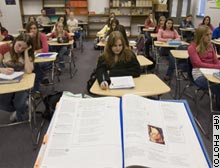
HARTLAND, Wisconsin (AP) -- Lauren Panos was surprised when she walked into her ninth-grade English class in the fall and saw there were no boys.
Her parents had not told her they had enrolled her in a new all-girls class at Arrowhead High School in Hartland, about 25 miles west of Milwaukee. A semester into classes, Panos still isn't sold on the idea.
"All the girls there, they can talk out of turn," the 14-year-old said. "We get really off task and it's really annoying."
More public school systems are looking at separating boys and girls, whether for certain classes or by entire schools, after the federal government opened the door last fall. Supporters say splitting students by sex minimizes distractions, helps them learn better and allows boys and girls to explore subjects they may not otherwise take.
Panos' classmate, Alyson Douglas, 15, said she likes not worrying about boys causing disruptions.
"Guys just make a bigger nuisance in the class," she said.
Panos' and Douglas' school is one of just three public schools in Wisconsin that offers classes for either boys or girls only. But Thursday night, the Milwaukee School Board approved a committee report calling for opening a school with all same-sex classes, perhaps by 2008.
Milwaukee would join several other large cities where public schools already offer single-sex classes. They include New York City -- where there are nine single-sex public schools -- as well as Chicago, Dallas, Seattle and Washington, D.C.
Plans to open same-sex schools have been announced in Miami, Atlanta and Cleveland.
Nationwide, at least 253 public schools offer single-sex classes and 51 schools are entirely single sex, according to the National Association for Single Sex Public Education. In 1995, just three public schools offered single-sex classes.
Critics of same-sex classrooms argue that proven methods of improving education should be pursued instead of one that divides boys and girls. Separating boys and girls is tantamount to "separate but equal" segregation-era classrooms, they say.
"Too many schools feel they can carry out a social experiment with students' education with really the flimsiest of theories," said Emily Martin, deputy director of the American Civil Liberties Union's Women's Rights Project.
Single-sex schools are an "illusionary silver bullet," said Lisa Maatz, director of public policy and government relations for the American Association of University Women. They distract from real problems and do not offer proven solutions such as lower class sizes and sufficient funding, she said.
Many classrooms and schools could make the switch thanks to a change made by the U.S. Department of Education in November.
Tuesday, January 23, 2007
NPR : Rafe Esquith Offers His Fiery Teaching Methods
NPR : Rafe Esquith Offers His Fiery Teaching Methods
All Things Considered, January 22, 2007 · Rafe Esquith is a trail-blazing, fast-talking, fifth-grade teacher who has racked up a slew of awards for his work at a public school in Los Angeles. Ninety-two percent of the children at the school live in households below the poverty level, but Esquith's students have reached the pinnacle of academic and artistic success. His fifth-graders are already tackling high-school fare: algebra, philosophy and Shakespeare.
Esquith's methods have been so successful that he has been encouraged to leave the classroom to help other instructors. But he has no interest in abandoning his kids. Instead, he wrote Teach Like Your Hair's on Fire: The Methods and Madness Inside Room 56, which Esquith likens to a cookbook for teaching in an urban classroom. The title of the book comes from an incident that occurred while he was helping a student in class with a chemistry experiment.
"In trying to get her alcohol burner to light, I set my hair on fire and didn't even know it until the kids started screaming," he says. "But as ridiculous as that was, I actually thought, if I could care so much I didn't even know my hair was on fire, I was moving in the right direction as a teacher — when I realized that you have to ignore all the crap, and the children are the only thing that matter."
He says his teaching tactics, however incendiary, apply to both teachers and parents.
Monday, January 22, 2007
Dairy could doom historic California town, group says - USATODAY.com

Dairy could doom historic California town, group says - USATODAY.com
Dairy could doom historic California town, group says
By John Ritter, USA TODAY
ALLENSWORTH, Calif. — A few restored buildings among sprawling flat acres of farmland are all that's left of an ambitious experiment a century ago — one doomed to fail but still an enduring symbol of African-American self-sufficiency.
Allen Allensworth, a former slave who rose to Army colonel, brought a colony of blacks here to a sparsely settled corner of the Central Valley in 1908. His vision was a discrimination-free town where blacks, through hard work and education, could compete in white America.
Unforeseen events killed the dream, but in the 1970s, the state preserved the town as a historical park. Today, Allensworth, an icon of black history, is threatened by a herd of cows, its patrons say.
Tulare County, the USA's top milk producer, has tentatively approved plans for a large dairy outside the 240-acre park. The Friends of Allensworth, a group with members across the state, fears odor and flies from 9,000 cows and their manure will drive visitors away. The group wants the dairy located somewhere else.
"Allensworth is one of a kind. It can't be replaced," says Victor Carter, president of the Friends of Allensworth. "It should be there for our youth, to see what we can accomplish given a chance." The park had 7,843 visitors in fiscal year 2006, according to the state parks department.
Ed Pope's family settled in Allensworth in the 1930s. He returned in retirement "to become a preservation activist on the scene." The park is on the National Register of Historic Places. If the dairy comes, Pope says, he could stand on railroad tracks next to the park "and throw a rock and hit a cow."
"If people stop coming, the state can't justify spending money to keep the park open. And if the park dies, Allensworth dies," says Pope, 77.
Saturday, January 20, 2007
NPR : Black Power on Display in New Congress

NPR : Black Power on Display in New Congress
The 110th session of Congress has an unprecedented number of African-American lawmakers in key positions of power. Black lawmakers with long seniority are taking over committees with influence on such fundamental issues as taxes, homeland security, trade and Social Security.
Some of these representatives – such as Charles Rangel and John Coyners – have been in Washington for decades. Coyners, who was first elected in 1964, helped establish the Congressional Black Caucus in 1969.
The Black Caucus gradually accumulated considerable influence on Capitol Hill, until the Republican takeover of Congress in 1994. Since then, Caucus members have seen their influence wane, rarely winning the ear of the Bush White House.
But last November's election brought a massive reversal of fortune for the Caucus. Now six of its members are poised to have a considerable impact on what happens in the House in the next two years.
Use the link to access more information about individual Caucus members.
Friday, January 19, 2007
Hispanics and Education - Hispanic Achievement
Hispanics and Education - Hispanic Achievement
Nowhere has the impact of the rapid growth of America’s Hispanic population been more apparent than in our elementary and high schools. The number of Hispanic K-12 students increased by almost 6 percent between 1993 and 2003, with Hispanics now accounting for 19 percent of public school students. Blacks make up 17.2 percent of the population while Whites posted a decrease, from 66 percent to 58 percent.
A report from The National Council of La Raza called “Hispanic Education in the United States” provides a more detailed account of how Hispanics compared to their peers in all levels of education.
The jump in the number of Hispanic K-12 students was most significant in the Western United States, where they rose from 15 percent in 1972 to 39 percent in 2003, surpassing Whites in the process. More than half of all immigrant youth are Hispanic (58 percent), with a larger portion in upper grades than lower grades.
Compared to other groups, dropout rates among Hispanics remains high and educational achievement relatively low. Barriers such as English language acquisition, immigration, insufficient financial aid and inadequate access to educational resources can explain the gaps between Hispanics and other students, say La Raza researchers.
The first issue to address is that of poverty. Roughly 49 percent of Hispanic and 48 percent of Black 4th-graders attend the public schools with the highest levels of poverty. Only 5 percent of White and 16 percent of Asian students are enrolled in similar schools. There are large state funding gaps between low- and high-poverty districts as well, especially in states with large minority populations, including California, Illinois and New York.
In 2004, Hispanics represented approximately 17 percent of all public high school students but graduated at a rate below the national average. Almost three-fourths of all Whites completed high school, compared to 53.2 percent of Hispanic students and only 50.2 percent of Blacks.
Nowhere has the impact of the rapid growth of America’s Hispanic population been more apparent than in our elementary and high schools. The number of Hispanic K-12 students increased by almost 6 percent between 1993 and 2003, with Hispanics now accounting for 19 percent of public school students. Blacks make up 17.2 percent of the population while Whites posted a decrease, from 66 percent to 58 percent.
A report from The National Council of La Raza called “Hispanic Education in the United States” provides a more detailed account of how Hispanics compared to their peers in all levels of education.
The jump in the number of Hispanic K-12 students was most significant in the Western United States, where they rose from 15 percent in 1972 to 39 percent in 2003, surpassing Whites in the process. More than half of all immigrant youth are Hispanic (58 percent), with a larger portion in upper grades than lower grades.
Compared to other groups, dropout rates among Hispanics remains high and educational achievement relatively low. Barriers such as English language acquisition, immigration, insufficient financial aid and inadequate access to educational resources can explain the gaps between Hispanics and other students, say La Raza researchers.
The first issue to address is that of poverty. Roughly 49 percent of Hispanic and 48 percent of Black 4th-graders attend the public schools with the highest levels of poverty. Only 5 percent of White and 16 percent of Asian students are enrolled in similar schools. There are large state funding gaps between low- and high-poverty districts as well, especially in states with large minority populations, including California, Illinois and New York.
In 2004, Hispanics represented approximately 17 percent of all public high school students but graduated at a rate below the national average. Almost three-fourths of all Whites completed high school, compared to 53.2 percent of Hispanic students and only 50.2 percent of Blacks.
Thursday, January 18, 2007
Jefferson, Blair Lead Nation In Intel Search Semifinalists - washingtonpost.com

Jefferson, Blair Lead Nation In Intel Search Semifinalists - washingtonpost.com: Thomas Jefferson High School for Science and Technology in Alexandria and Montgomery Blair High School in Silver Spring together produced 26 of 300 semifinalists nationwide in the prestigious Intel Science Talent Search for 2007, the technology company announced yesterday.
The schools, which draw students with conspicuous math and science abilities from Northern Virginia and Montgomery County, respectively, ranked first and second for the number of semifinalists from a single campus in the annual contest. Jefferson had 14; Blair had 12.
The D.C. region yielded 31 semifinalists in all, 10 percent of the nation's total, with one each from Bethesda-Chevy Chase, Walt Whitman and Thomas Wootton high schools in Montgomery, Eleanor Roosevelt in Prince George's County and the private Sidwell Friends School in the District. Jefferson and Blair are perennial contenders because of their math-science magnet programs.
A "prize patrol" from the talent search visited Blair yesterday to present the school's semifinalists with $1,000 checks; schools receive a matching sum for each honoree. A similar ceremony for Jefferson's 14 semifinalists was canceled because of a power outage at the school.
Forty finalists will be announced Jan. 31. On March 8, finalists will travel to Washington for a week-long event, culminating with 10 students receiving scholarships totaling $500,000. The top winner will receive a $100,000 scholarship.
The talent search, founded in 1942, is the nation's oldest and most highly regarded pre-collegiate science contest.
Overall cancer deaths decline again, but statistics not as rosy for blacks - USATODAY.com
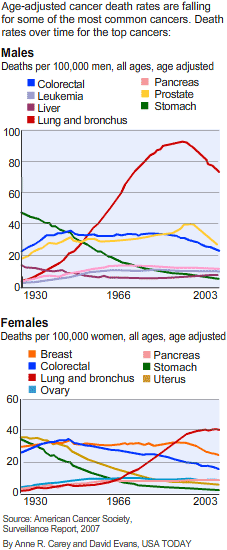
Overall cancer deaths decline again, but statistics not as rosy for blacks - USATODAY.com: The number of Americans dying of cancer declined for second year in a row, this time by a much greater number, the American Cancer Society reports, a signal that decades of advances in prevention and treatment are paying off, experts say.
Although black women have a 9% lower cancer rate than their white peers, black women have an 18% higher death rate for all forms of cancer. Black men have a 15% higher rate of cancer and a 38% higher death rate than white men, a trend that extends from 1999 to 2003.
Tuesday, January 16, 2007
Whatever happened to Ruby Bridges? - Nightly News with Brian Williams - MSNBC.com
Whatever happened to Ruby Bridges? - Nightly News with Brian Williams - MSNBC.com: NEW ORLEANS - Ruby Bridges didn't ask to be an icon of the civil rights movement; others made that happen.
She was, after all, just six in 1960 when the NAACP selected her to integrate a New Orleans elementary school.
An angry mob tried to keep her out, but federal marshals got her in.
And Norman Rockwell made the moment famous in a 1964 painting.
Forty-six years later, after Katrina flooded the city, devastated the school and triggered a new round of racial upheaval, Ruby Bridges is back, this time on her own accord — to save the school.
Even before Katrina, William Frantz Elementary in the Lower Ninth Ward was in danger of closing.
“I used to go to the back to sharpen my pencil, there,” says Bridges as she takes us on a tour. “I see this school being filled with kids.”
But there's more. Bridges wants to integrate the school — again.
Monday, January 15, 2007
King's own words on display for his holiday - USATODAY.com
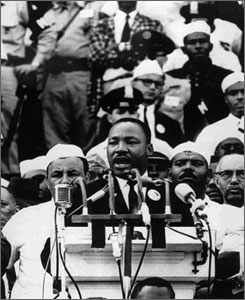
King's own words on display for his holiday - USATODAY.com: The handwritten personal papers of Martin Luther King Jr., including his sermons and the 'I Have a Dream' speech, will be on display in Atlanta today, one of many tributes planned for the late civil rights leader.
Schools, banks, federal offices and post offices are closed today as the nation observes the 21st annual King holiday.
In Washington, D.C., the Martin Luther King Jr. National Memorial Project Foundation is announcing $3 million in new contributions from corporations. That will bring the total raised to $76 million toward a goal of $100 million. The memorial will be built along the Tidal Basin, between the Jefferson and Lincoln memorials.
King, who was assassinated in 1968, would be 78 years old today.
'He was the irresistible force that made the immovable object of segregation move,' Sen. Edward Kennedy, D-Mass., said Sunday. 'We who admired him so much can honor him the most by carrying on his work. Civil rights is still the unfinished business of America.'
The memorial is scheduled for completion in 2008. It will be the first memorial on the National Mall for a non-president and the first for an African-American.
The Atlanta History Center opens an exhibit today of King's handwritten papers. One is his 'I Have a Dream' speech, delivered to 200,000 people from the steps of the Lincoln Memorial during the March on Washington in August 1963. Also being displayed is King's 'Letter from Birmingham Jail,' in which he laid out his opposition to segregation and said citizens had an obligation to disobey unjust laws.
The papers are from the Morehouse College Martin Luther King Jr. Collection.
Legislation signed into law by President Reagan in 1983 designated the third Monday in January as Martin Luther King Day. The holiday, first observed in 1986, is timed to fall on or around King's birthday, Jan. 15.
Despite Lessons on King, Some Unaware of His Dream - washingtonpost.com
Despite Lessons on King, Some Unaware of His Dream - washingtonpost.com: In a recent survey of college students on U.S. civic literacy, more than 81 percent knew that the Rev. Martin Luther King Jr. was expressing hope for 'racial justice and brotherhood' in his historic 'I Have a Dream' speech.
That's the good news.
Most of the rest surveyed thought King was advocating the abolition of slavery.
The findings indicate that years of efforts by primary and secondary schools to steep young people in the basics of the civil rights leader's life and activities have resulted in a mixed bag. Most college students know who he is -- even if they're not quite clear on what he worked to achieve.
Students and teachers say today's federal holiday marking King's birthday is the one that receives the most attention in schools, in part because the events surrounding the man it commemorates are the most recent.
"I think if there is one holiday on the calendar that is really reflective and thoughtful and has historical content, it is the King holiday," said Cynthia Mosteller, a history teacher at Deal Junior High School in the District. "It is a topic about which literally every student knows something."
How long students will continue to learn it, however, is open to question, students and educators say.
The recent survey of college students, conducted by the University of Connecticut's Department of Public Policy for the nonprofit Intercollegiate Studies Institute, suggests that schools are not doing as much as they could to go beyond a cursory history lesson. More than 14,000 college freshmen and seniors at 50 colleges and universities earned an average score of 53.2 percent in the survey.
Sunday, January 14, 2007
Memorial honoring MLK to receive funding boost - USATODAY.com
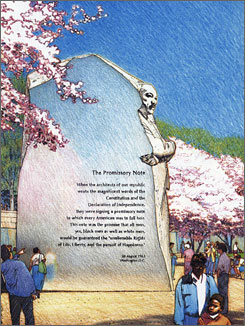
Memorial honoring MLK to receive funding boost - USATODAY.com: WASHINGTON — Alfred C. Bailey, too, had a dream.
About 20 years ago, the retired engineer and his Alpha Phi Alpha fraternity brothers sat around a dining room table, talking about the late Rev. Martin Luther King Jr.
Memorials to King had been erected around the country, but there was nothing in Washington, D.C., where he made his famous 'I have a dream' speech about a future of racial harmony on the steps of the Lincoln Memorial in the summer of 1963.
'We knew he deserved it, so we dedicated ourselves to getting it done,' said Bailey, 82, of Silver Spring, Md.
Today, 21 years after the first federal holiday honoring Martin Luther King Jr., the dream King's fraternity set in motion is almost realized.
The Martin Luther King Jr. National Memorial Project Foundation Inc., has raised $72.9 million in mostly private donations to fund a memorial on the National Mall and will announce Monday that corporate donors will be contributing at least $2 million.
The foundation is asking churches over the next year to sponsor a collection for the memorial, which is expected to cost $100 million.
Scheduled for completion in late 2008, the memorial will be located on a four-acre site along the Tidal Basin, surrounded by memorials to Presidents Franklin D. Roosevelt, Abraham Lincoln, Thomas Jefferson and George Washington.
It will be the first memorial on the mall for a non-president and African American.
'I don't have any question that we're on track,' said Harry Johnson, the foundation president.
The memorial will include waterfalls, a wall of quotes, and boulders, including one with a carving of King's image and words.
Bailey helped pick the design. He was among the more than 200,000 people who heard King's 1963 speech during the March on Washington, and he was inspired.
Bailey remembers, as a young soldier in 1943, having to travel through small Southern towns with the curtains drawn on his train car because the residents 'didn't want to see black people.' And 10 years later, he and his wife slept in their car when they ran out of gas after the local gas station closed and no hotel would take them.
'That's why I could feel so good when Martin spoke about freedom for all because I had experienced segregation,' Bailey said. The memorial, he said, 'will be so worthwhile to many generations to come.'
Equal Cheers for Boys and Girls Draw Some Boos - New York Times

Equal Cheers for Boys and Girls Draw Some Boos - New York Times: WHITNEY POINT, N.Y. — Thirty girls signed up for the cheerleading squad this winter at Whitney Point High School in upstate New York. But upon learning they would be waving their pompoms for the girls’ basketball team as well as the boys’, more than half of the aspiring cheerleaders dropped out.
The eight remaining cheerleaders now awkwardly adjust their routines for whichever team is playing here on the home court — “Hands Up You Guys” becomes “Hands Up You Girls”— to comply with a new ruling from federal education officials interpreting Title IX, the law intended to guarantee gender equality in student sports.
“It feels funny when we do it,” said Amanda Cummings, 15, the cheerleading co-captain, who forgot the name of a female basketball player mid-cheer last month.
Whitney Point is one of 14 high schools in the Binghamton area that began sending cheerleaders to girls’ games in late November, after the mother of a female basketball player in Johnson City, N.Y., filed a discrimination complaint with the United States Department of Education. She said the lack of official sideline support made the girls seem like second-string, and violated Title IX’s promise of equal playing fields for both sexes.
But the ruling has left many people here and across the New York region booing, as dozens of schools have chosen to stop sending cheerleaders to away games, as part of an effort to squeeze all the home girls’ games into the cheerleading schedule.
Boys’ basketball boosters say something is missing in the stands at away games, cheerleaders resent not being able to meet their rivals on the road, and even female basketball players being hurrahed are unhappy.
In Johnson City, students and parents say they have accepted the change even as they question the need for it.
NPR : 'Until the Building Falls Down': A Fight to Vote

NPR : 'Until the Building Falls Down': A Fight to Vote: Theresa Burroughs was 18 years old and ready to vote. But in her Alabama town, it took two years of effort just for her to register.
Accompanied by J.J. Simmons, a minister who would not let her back down, Burroughs went down to the Hale County Courthouse on the first and third Monday of each month.
'The white men,' Burroughs says, 'they would not let us register to vote.'
The chairman of the board of registrars, remembered by Burroughs only as 'Mr. Cox,' posed questions meant to disqualify black voters, such as 'How many black jelly beans in a jar? How many red ones in there?'
When Burroughs responded that Cox didn't know how many jelly beans were in the jar any more than she did, the answer was quick: 'Shut your black mouth.'
But Burroughs, with Simmons' support, kept on going, despite the embarrassment.
'We're going to go until the building falls down,' Simmons said.
On the day that Cox finally relented, he asked Burroughs and Simmons a simpler question — to recite part of the preamble of the Constitution — and also gave her a final insult.
'You're going to pass today. Because we are tired of looking at your black faces,' Burroughs recalls him saying. Then he handed over the slip of paper that meant Burroughs was a registered voter.
Burroughs voted in the next election. And she hasn't stopped since.
'It shouldn't have been this hard,' she says. 'I knew it shouldn't have been this hard.'
Subscribe to:
Posts (Atom)