Sunday, January 14, 2007

Emerging Scholars: The Class of 2007


Emerging Scholars: The Class of 2007: Just 10. Each year it becomes increasingly difficult to select just 10 Emerging Scholars. There are so many outstanding scholars of color in the academy who are breaking new ground in research, applying scholarship to public policy and grooming the next generation of leaders and professionals.

Diverse’s 2007 Emerging Scholars are doing all of that while setting records and earning the distinction of being the “first” or the “youngest” to win tenure or merit some impressive accolade.

This year’s crop of award-winning academicians was chosen by Diverse staff and, in some cases, nominated by colleagues. The scholars include a scientist who uses GIS technology to map racial health disparities; a first-generation college graduate and doctorate who is a highly sought-after computer expert; and a math prodigy who was studying college-level calculus at age 9 and earned his doctorate at age 20.

Some of our scholars benefited from the encouragement of mentors or pipeline programs like The PhD Project. Some, destined for stellar private industry careers, came to the academy by happenstance. All are driven and exceptional.
See for yourself.

Perspectives: King Holiday Opportunity For Change

Perspectives: King Holiday Opportunity For Change: Recently, I drove by a place of worship and read “new year, new hope.” I thought there was something quite prophetic in that short message. As we know, America will celebrate the Martin Luther King Jr. holiday on Jan. 15th. On that day, we will pause to reflect on the greatness of the man and to re-commit ourselves to his principles of fairness and justice. Many of us have found his philosophy to be quite simple. He wanted all of us to treat one another with great dignity and respect. Turning talk into action, however, causes us the trouble.

“Hatred and bitterness can never cure the disease of fear; only love can do that,” King said. “Hatred paralyzes life; love releases it. Hatred confuses life; love harmonizes it. Hatred darkens life; love illuminates it.” On Jan. 15th, there will be wonderful speeches, personal testimonies and great singing. On this day, I would like to believe we will all be on the same page. We will talk passionately about our love for one another. There is something truly special about the activities on this day. Places of worship, auditoriums and other edifices will be filled with people singing, “We shall overcome some day.” I enjoy the spirit that comes with this great song. I believe with all of us working together that we can capture this spirit year round.

Coretta Scott King honored in Atlanta - Race in America - MSNBC.com


Coretta Scott King honored in Atlanta - Race in America - MSNBC.com

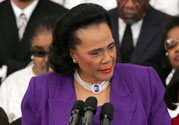
ATLANTA - It’s been a year since Coretta Scott King received thunderous applause when she surprised guests at the annual Salute to Greatness Dinner and appeared on stage, smiling and waving with her children.

On Saturday, guests again applauded the widow of Martin Luther King Jr., as she was honored posthumously for her human rights contributions and work to preserve her husband’s legacy in the decades after his death.

King suffered a stroke and heart attack in August 2005 and battled ovarian cancer before she died in January 2006.

Friday, January 12, 2007

Classroom Instruction that Works with English Language Learners - McREL


Classroom Instruction that Works with English Language Learners - McREL

Classroom Instruction that Works with English Language Learners applies the strategies from the best-selling book Classroom Instruction that Works to reaching English language learners (ELLs). It describes ways for mainstream K–6 teachers to adapt the strategies to meet the needs of ELLs at different stages of language acquisition. Teachers also will learn how to use culturally appropriate methods to increase parents' involvement in the education process.

Wednesday, January 10, 2007

Tolerance.org: Teaching Tolerance: IN THE NEWS: Martin Luther King, Jr. Day; No Name-Calling Week

Tolerance.org: Teaching Tolerance: IN THE NEWS: Martin Luther King, Jr. Day; No Name-Calling Week: IN THE NEWS: Martin Luther King, Jr. Day; No Name-Calling Week

Jan. 10, 2007 -- Tolerance-related news events, with discussion questions and resources for classroom use
by Carrie Kilman

Professors Offer Realistic Look at King
Next Monday, the United States will observe Martin Luther King, Jr. Day. How will your classroom celebrate?

Dr. King was assassinated on April 4, 1968. Four days later, U.S. Rep. John Conyers (D-Mich) introduced a bill to create a national holiday in King's honor. But the bill stalled. For 15 years, members of Congress reintroduced the bill, but Congress steadfastly refused to pass it.

By November 1980, the bill lost by only 5 votes. Public support for a national holiday was growing. In 1982, more than 6 million people signed petitions urging Congress to pass the legislation. In August 1983, after continued public pressure, the King Holiday Bill passed the House by a vote of 338 to 90. But the fight wasn't over. In the Senate, the bill's fate was uncertain.

Later that month, 750,000 protesters marched to the Lincoln Memorial for the 20th Anniversary March on Washington, demanding the Senate and President Reagan take action. Two months later, the bill cleared the Senate. In November 1983, President Reagan ceremoniously signed it into law, while Coretta Scott King, Dr. King's widow, looked on.

Many states objected to the new holiday and refused to recognize it. In protest of the new law, several Southern states created holidays for Confederate generals on the same day as King's holiday. It wasn't until 1999 that Martin Luther King, Jr. Day was celebrated in all 50 states. Today, the holiday is celebrated, in some form, in more than 100 countries.

Explore King's influence and the history of Martin Luther King, Jr. Day in your state.

Tolerance.org: Speak Up!

Tolerance.org: Speak Up!

Your brother routinely makes anti-Semitic comments. Your neighbor uses the N-word in casual conversation. Your co-worker ribs you about your Italian surname, asking if you're in the mafia. Your classmate insults something by saying, "That's so gay."

And you stand there, in silence, thinking, "What can I say in response to that?" Or you laugh along, uncomfortably. Or, frustrated or angry, you walk away without saying anything, thinking later, "I should have said something."

In the spring of 2004, the Southern Poverty Law Center gathered hundreds of stories of everyday bigotry like these from people across the United States. They told their stories through e-mail, personal interviews and at roundtable discussions in four cities: Baltimore, Md.; Columbia, S.C.; Phoenix, Ariz.; and Vancouver, Wash.

People spoke about encounters in stores and restaurants, on streets and in schools. They spoke about family, friends, classmates and co-workers. They told us what they did or didn't say — and what they wished they did or didn't say.

And no matter the location or relationship, the stories echo each other.

When a Native American man at one roundtable discussion spoke of feeling ostracized at work, a Jewish woman nodded in support. When an African American woman told of daily indignities of racism at school, a white man leaned forward and asked what he could do to help. When an elderly lesbian spoke of finally feeling brave enough to wear a rainbow pin in public, those around the table applauded her courage.

Speak Up! echoes that applause, encouraging everyone to take a stand against everyday bigotry.

Tolerance.org: Teaching Tolerance: IVORY TOWER: Lessons for a Teacher


Tolerance.org: Teaching Tolerance: IVORY TOWER: Lessons for a Teacher: IVORY TOWER: Lessons for a Teacher

Veteran teacher Dottie Blais writes openly about a question that too often is left unspoken and unanswered: How does a teacher's whiteness get in the way of successful multicultural education?

by Dottie Blais

Only one student ever told me to my face that she hated me and meant it. It happened more than 20 years ago, and I'll never forget the moment.

Shonda and I were seated across from each other in the shabby chairs of the teachers' lounge at the public high school of a small town in the Deep South. It was the only place I'd been able to find for our impromptu conference, and the matter at hand was urgent. Shonda wanted to drop out of the gifted program; in fact, she had already stopped coming to class. She had been vague with the counselor about her reasons, and she had not discussed the decision with me.

In our conference, I bombarded her with well-intentioned questions: What's going on? Is anything wrong at home? Why didn't you tell me you were having problems?

Her quiet answer shocked me: "I hate you."

"What?" I asked, even though I had heard quite clearly what she said.

"I hate you," she repeated without embellishment.

"Wh . . . Why?" I asked. But the conference was over because Shonda ran out of the room. Stunned, I couldn't even get out of my chair to go after her.

So Shonda dropped out of the program. Her parents didn't argue with her about her decision because they knew how strong-willed she was, and they wanted her to be happy. She simply stopped talking to me. For nearly a year I was left with unanswered questions. What had I done to elicit such hatred from her? How could I have failed her so miserably?

Tuesday, January 09, 2007

Stamp honors Fitzgerald, First Lady of Song - MUSIC - MSNBC.com


Stamp honors Fitzgerald, First Lady of Song - MUSIC - MSNBC.com

Ella Fitzgerald — the First Lady of Song — is being honored on a new postage stamp.

The 39-cent stamp will be released Wednesday at ceremonies at Jazz at Lincoln Center in New York, and will be on sale across the country. It’s the 30th stamp in the agency’s Black Heritage series.

“She would be very honored, very pleased and a little surprised,” said Ray Brown Jr., Fitzgerald’s son. “She didn’t go through life expecting all the accolades that she got. She was just happy to do her thing and be the best that she could be.”

An Educator's Stirring Coda - washingtonpost.com


An Educator's Stirring Coda - washingtonpost.com: More than 200 musicians came dressed in their concert black, toting trumpets, saxophones and violins that many had first picked up at age 11. Now with some in high school or college and others in their 20s and 30s, many had barely met before performing yesterday for about 1,200 people at Bethesda's Walt Whitman High School auditorium.

But they all wanted to please Frankie Ball, the tall, sharply dressed man in the front row bobbing his head to the beat.

Ball, 61, instrumental music teacher at nearby Thomas W. Pyle Middle School for 26 years, is retiring this month to focus on his cancer treatments. In a concert featuring a band, a string orchestra and two jazz ensembles, Ball's former students gathered to honor the beloved teacher credited with instilling musical appreciation in thousands of Bethesda children. Proceeds from ticket sales will benefit cancer research.

Monday, January 08, 2007

U.S. Education Officials Question Diversity Standard - washingtonpost.com

U.S. Education Officials Question Diversity Standard - washingtonpost.com: The Education Department's general counsel is challenging the American Bar Association's new standard on diversity in enrollment and hiring, which calls for the law schools it accredits to take 'concrete action' to attract more minority students, faculty and staff.

The 400,000-member law association, which has accredited nearly 200 law schools nationwide, said it updated its standards last year after a 2003 Supreme Court ruling that said law schools could use race and ethnicity as factors in admissions with certain restrictions.

Friday, January 05, 2007

NCCRESt - National Forum 2007

NCCRESt - National Forum 2007

This year’s conference, Leadership for Equity and Excellence: Transforming Education, will be held in Washington D.C. at the Crystal Gateway Marriott on February 7th, 8th, and 9th, 2007. Educators, policy makers, advocacy groups, parents, and community members from across the United States will gather to explore how educational systems can assure equity in educational outcomes for all students through school improvement, leadership, family and community partnerships, policy, and teaching.

The focus for the three days will be to share current research, best practices, and tools for transforming educational systems. Last years conference drew over 500 of the nation’s top education experts, leading educators, policy makers, advocacy groups, parents, and community members. Comments from conference participants were…

This is the best conference I’ve attended in 10 years!

General education leaders need to attend this conference!

The sessions were outstanding!

NCCRESt will have more information posted as soon as it is available. Check the site often for information on call for proposals, online registration and keynote speakers.

Thursday, January 04, 2007

Minorities and Science and Engineering Degrees: Attainment Statistics


Minorities and Science and Engineering Degrees: Attainment Statistics: Women have made significant progress in science and engineering, having earned half of bachelor’s degrees, 44 percent of master’s degrees and 37 percent of doctorates in science and engineering in 2003-2004. African Americans, Hispanics and American Indians continue to be under-represented, collectively earning 16 percent of bachelor’s degrees, 11 percent of master’s and barely 6 percent of doctorates for the same period, according to a report released Wednesday.

Other key highlights of the 16th edition of Professional Women and Minorities from the Commission on Professionals in Science and Technology include:

· Since 1966, the percentage of bachelor’s degrees earned by women in science and engineering doubled from 24.8 percent to 50.4 percent in 2004.

· In 1966, women only earned 13.3 percent S&E master’s, but that figure tripled to 43.6 percent in 2004.

· Women earning doctorates showed the most growth; 37.4 percent of doctorates went to women in 2004, compared to 8.0 percent in 1966.

Despite their gains in degree attainment, women represented 25 percent of the science, technology, engineering and mathematics labor force in 2005. Women were mostly represented in social sciences, biological sciences, and psychology related occupations, but least represented in mechanical and civil engineering occupations.

Sunday, December 31, 2006

No-loan Financial Aid, Diversity, and Ivy League Universities - Princeton, Harvard, Dartmouth

No-loan Financial Aid, Diversity, and Ivy League Universities - Princeton, Harvard, Dartmouth: "

Just the Stats: Does No-Loan Financial Aid Really Improve Diversity?
By Olivia Majesky-Pullmann


In an effort to increase racial and economic diversity, many Ivy League institutions are implementing very generous financial aid policies that guarantee that low-income students will graduate without incurring debt. But are these aggressive new policies really working?

To find out, Diverse took a look at some of the top Ivy League universities, including Dartmouth College, Princeton University and Harvard University. "

Hispanic Teenagers Join Southern Mainstream - New York Times


Hispanic Teenagers Join Southern Mainstream - New York Times: While Hispanics now account for more than 20 percent of the population here, they still live mostly on the margins of society, largely invisible in local politics and the upper echelons of business. As adults, Hispanics, blacks and whites rarely mix socially.

But in the bustling classrooms of Atkinson High, Hispanic teenagers are slowly but steadily integrating into student life. The transition is sometimes awkward and painful, but young people here are casually challenging the traditional social hierarchy in ways once unimaginable.

BEING A BLACK MAN - series: In or Out Of the Game? - washingtonpost.com


In or Out Of the Game? - washingtonpost.com: "A guy once told him something he still finds profound: The reason the guy smoked drugs, he said, was because he was afraid his life wouldn't turn out well. 'You go to Georgetown, and see white people all chipper,' James says. 'And then you go to the neighborhood and our people are all mad. And the question you have to ask yourself is: Why?'

Friday, December 29, 2006

Study Links Obesity and Bottle-Fed Child - New York Times

Study Links Obesity and Bottle-Fed Child - New York Times: WASHINGTON, Dec. 28 (AP) — Far too many children are fat by preschool, and Hispanic youngsters are most at risk, according to research that is among the first to focus on children growing up in poverty.

One important predictor of a pudgy preschooler was whether the child was still using a bottle at the age of 3, said the study, which was published online Thursday by the American Journal of Public Health.

“These children are already disadvantaged because their families are poor, and by age 3 they are on track for a lifetime of health problems related to obesity,” said the lead researcher, Rachel Kimbro of the University of Wisconsin, Madison.

Seventeen percent of American youngsters are obese, and millions more are overweight. Dr. Kimbro focused on poverty, culling data on more than 2,000 3-year-olds from a study that tracks from birth children who were born to low-income families in 20 large American cities.

Thirty-two percent of the white and black children studied were overweight or obese, as were 44 percent of the Hispanic children.

Why were the Hispanic children at higher risk? Dr. Kimbro checked a long list of factors, but nothing could fully explain the difference. Children were particularly at risk if their mothers were obese. So were those who still took a bottle to bed at age 3, as did 14 percent of the Hispanic youngsters, 6 percent of the white children and 4 percent of the black children.

The Old Kinship - washingtonpost.com


The Old Kinship - washingtonpost.com: Once, they were young men, living in the South, raised by a black community that provided love and sustained attention. They folded into a fraternity of men who preached self-reliance and offered protection, humor and support during their shared struggles. In white places, where a black boy could be jailed or beaten, the world was fraught and perilous. And they might be the last generation of black men who share the memory of being deliberately taught how to walk in the world.

'When we were in the South, that's all we had was each other. We were still competing in school or athletics or whatever, being the best we could be, but we still had the community,' Hodges said. And community held you up. Black people have lost that, the bowler said. 'We're separate now. Now, we're fragile.'

Wednesday, December 27, 2006

NPR : Covert, Michigan: A History in Black and White


NPR : Covert, Michigan: A History in Black and White: On the Midwestern frontier in the 1860s, the settlers of Covert, Mich., lived as peers, friends and sometimes even kin. What makes the story unusual is that they were both black and white.

The graveyard is eloquent testimony to their remarkable lives. There are hardscrabble pioneers and a lumberman whose tombstone has been cast from a tree trunk. The cemetery is one of very few in the country where black and white Civil War veterans lie together.

It's the sense of shared fate that attracted historian Anna-Lisa Cox to Covert. For more than a decade, she traced the tales of the town's pioneers. Earlier this year, she published a book on the subject.

The Roods -- Mayflower descendants -- came to Covert in the 1860s. So did the Pompeys, who were farmers and black soldiers.

'And they're actually about as close in the graveyard as they were in life,' Cox says.

Covert was not one of the abolitionist colonies established in the Midwest at the time, following an anti-slavery philosophy. Nor was it a free African-American settlement protected by the Quakers. It wasn't a utopian social experiment. It was, quite simply, tough frontier, and somehow it was a place where individuals laid the foundation for a culture of trust in one another.

And it endured.

Tuesday, December 26, 2006

Nanny Hunt Can Be a ‘Slap in the Face’ for Blacks - New York Times


Nanny Hunt Can Be a ‘Slap in the Face’ for Blacks - New York Times: Numerous black parents successfully employ nannies, and many sitters say they pay no regard to race. But interviews with dozens of nannies and agencies that employ them in Atlanta, Chicago, New York and Houston turned up many nannies — often of African-American or Caribbean descent themselves — who avoid working for families of those backgrounds. Their reasons included accusations of low pay and extra work, fears that employers would look down at them, and suspicion that any neighborhood inhabited by blacks had to be unsafe.

The result is that many black parents do not have the same child care options as their colleagues and neighbors. They must settle for illegal immigrants or non-English speakers instead of more experienced or credentialed nannies, rely on day care or scale back their professional aspirations to spend more time at home.

“Very rarely will an African-American woman work for an African-American boss,” said Pat Cascio, the owner of Morningside Nannies in Houston and the president of the International Nanny Association.

Many of the African-American nannies who make up 40 percent of her work force fear that people of their own color will be “uppity and demanding,” said Ms. Cascio, who is white. After interviews, she said, those nannies “will call us and say, ‘Why didn’t you tell me’ ” the family is black?

Sunday, December 24, 2006

Special Agent - washingtonpost.com


Special Agent - washingtonpost.com:... Growing up on the South Side of Chicago, he had known guys like the one he was pretending to be, but he had avoided them. He was the Boy Scout who never used drugs or smoked, the kid who worked his way through Catholic school and college, who had gone on to command a platoon in the Marines.

'I wanted to stand up and tell everybody, 'Yes, I'm a black man,' ' he said. 'But I'm an FBI agent. I was in the Marines. I'm a college graduate.

'People were looking at me like I was dirt. Like I was trash.'

And there it was. For his entire life, Mason had been determined to not be defined by race. But race was a formidable foe. Even though he knew the arrest was fake and he probably would never see the onlookers again, the feelings had cornered him there on the ground -- and they cut deep.

Friday, December 22, 2006

NPR : A Close Bond Sheds Light on Race Relations


NPR : A Close Bond Sheds Light on Race Relations: When Amanda Fernandez met Sarah Luzietti three years ago, she knew right away that there was something special about her fellow ninth grader.

She saw Luzietti under a tree, listening to jazz music. 'I knew that white people listened to jazz, but I didn't know that kids my age could appreciate the original black music. She was listening to Ella and she had Miles in there. It was just like, 'Wow, there's something different about her.''

It was a difference that felt familiar to the girls, who are now both 17 and seniors at the Duke Ellington School of the Arts in Washington, D.C.

Educators want to reopen 'Brown v. Board' school - USATODAY.com


Educators want to reopen 'Brown v. Board' school - USATODAY.com: Fifty-six years ago, the Rev. Oliver Brown and 12 other black parents helped kick-start the civil rights movement when they tried to enroll their children in all-white schools in Topeka, Kan. The schools' refusal helped give rise to the U.S. Supreme Court's landmark 1954 Brown v. Board of Education of Topeka case, which led to school desegregation nationwide.

Brown's old neighborhood school, Sumner Elementary, has been shuttered for years. Now two black Kansas educators want to turn it into a charter school for at-risk students, most of whom, they say, will be black or Hispanic. Their bid, which goes before the Topeka school board next month, has a certain symbolic importance: Not only would it reopen the landmark building, potentially to children of all races — it illustrates just how far the discussion on race and schooling has moved since Brown.

The proposal is backed by Cheryl Brown Henderson, one of Brown's daughters, who heads the Brown family foundation. She is on the governing board, whose plan includes a proposal to buy Sumner from the city and raise up to $5.5 million to renovate it.

Thursday, December 21, 2006

ESL Magazine - the leading magazine for American English language teachers for ESL EFL ESOL and TEFL - U.S. Language Demographics Online

ESL Magazine - the leading magazine for American English language teachers for ESL EFL ESOL and TEFL - U.S. Language Demographics Online: The Modern Languages Association (MLA) has launched a new online, interactive map profiling the multilingual demographics of the U.S. The map is derived from the results of the vast U.S. Census 2000 which collected detailed data on people living in the U.S. The huge database of results has been analysed and published and provides, amongst many other findings, a record of the languages spoken at home, as well as information about English proficiency. The MLA has used this data, together with state and zip information, to provide a accurate profile every region of the U.S. To view the map, visit www.mla.org/census_map

Despite Modest Increase, GED Test-Taking Still Hovering Near All-Time Low

Despite Modest Increase, GED Test-Taking Still Hovering Near All-Time Low: Given recent statistics that indicate that at least half of all Black and Hispanic high school students dropped out this year, the General Educational Development test, or GED, remains a critical second option. However, since 2002, when the test was revamped to address complaints that GED-holders lacked basic writing skills, the number of test-takers has fallen drastically, from 800,000 before 2002 to 665,927 in 2004.

However, a report issued by the GED Testing Service today entitled, “Who Passed the GED Tests? 2005 Statistical Report,” shows a modest 2.2 percent increase in the number of GED test-takers for 2005, to 680,874. Also, the total number of GED candidates who passed the test rose 4.4 percent to 423,714 from 405,724 in 2004.

All of this is good news for GED Testing Service Executive Director Sylvia E. Robinson who, after assuming her post in April, has been charged with boosting sagging GED test-taking numbers while steering the GED toward another redesign, scheduled for 2011. She says, however, that the GED has a long way to go.

Women in Science: The Battle Moves to the Trenches - New York Times


Women in Science: The Battle Moves to the Trenches - New York Times: HOUSTON — Since the 1970s, women have surged into science and engineering classes in larger and larger numbers, even at top-tier institutions like the Massachusetts Institute of Technology, where half the undergraduate science majors and more than a third of the engineering students are women. Half of the nation’s medical students are women, and for decades the numbers have been rising similarly in disciplines like biology and mathematics.
Yet studies show that women in science still routinely receive less research support than their male colleagues, and they have not reached the top academic ranks in numbers anything like their growing presence would suggest.

For example, at top-tier institutions only about 15 percent of full professors in social, behavioral or life sciences are women, “and these are the only fields in science and engineering where the proportion of women reaches into the double digits,” an expert panel convened by the National Academy of Sciences reported in September. And at each step on the academic ladder, more women than men leave science and engineering.

Escaping 'Average' - washingtonpost.com


Escaping 'Average' - washingtonpost.com: The focus on helping average students also boosted minority enrollment in the most rigorous classes. The district has about 3,400 students, 40 percent black and slightly more than half white. Through the initiative, administrators found more black students doing well and going on to college.

Julius Mullen, who directs a Saturday program for young African American males in Seaford, said the students discovered they could advance if given more time and the assurance that they had their friends with them. 'When expectations are raised, I think students will grab for them if they have the support programs in place,' Mullen said. 'They have to see their friends achieving success.'

Ideas to aid black youths - baltimoresun.com

Ideas to aid black youths - baltimoresun.com: State schools Superintendent Nancy S. Grasmick, chairwoman of the task force, said the next step is to define what body in Maryland is responsible for each of the recommendations in the report.

The report calls for school systems to stop placing large numbers of black males in special-education classes, where they are over-represented, and stop sending them home when they are suspended instead of providing constructive punishment inside the school.

The report also endorses the use of more single-sex classes inside regular schools, saying research points to a rise in academic achievement among boys segregated by gender.

African-American males also need to be challenged in higher-level courses and need to understand what it takes to get into college, the report says. So it recommends increasing the number of students who take PSATs and Advanced Placement classes.

The disparity in academic achievement for African-American males has remained a persistent problem.

In 2003, 76 percent of white males graduated from high school, compared with 53 percent of black males in Maryland.

For every four black men in college, there are three behind bars.

Only a small percentage of black men get to college, and fewer still graduate. In Maryland, black men earn 15 percent of master's degrees and 7 percent of doctorates.

Special-Ed Changes To Get Trial Run - washingtonpost.com

Special-Ed Changes To Get Trial Run - washingtonpost.com: Ten Montgomery County middle schools plan a new approach to special education next year that stresses academic progress and includes special-needs students in mainstream classrooms as a means to jump-start lagging performance under the federal No Child Left Behind initiative.

The pilot program, called hours-based staffing, is part of an urgent effort around the region to rethink special education, or risk widespread failure under the federal mandate. Poor performance by special education students is the leading reason Maryland schools have not made 'adequate yearly progress' toward proficiency levels all students are supposed to meet by 2014. Special education was the sole factor for half of the 38 Montgomery schools that missed the targets this year.

Program Widens School Funding Gap, Report Says - washingtonpost.com

Program Widens School Funding Gap, Report Says - washingtonpost.com: Rich States Are Found to Get More Than Poor Ones in $13 Billion Effort to Aid Low-Income Students

By Amit R. Paley
Washington Post Staff Writer
Thursday, December 21, 2006; Page A04

A $13 billion federal program to help students from low-income families has actually widened an education funding gap between rich and poor states, according to a study released yesterday.

The program, known as Title I, is part of a slew of federal, state and local policies that direct more resources to the nation's wealthiest children than to its poorest, the study concluded. It found that the highest-poverty school districts receive an average of $825 less each year per student in state and local funding than the wealthiest districts. It also found that state and local money often flows disproportionately to wealthy students within districts.

Tuesday, December 19, 2006

Study Warns of Hunger Problem Among Hispanics - washingtonpost.com

Study Warns of Hunger Problem Among Hispanics - washingtonpost.com: Nearly one in five Hispanics lacks sufficient access to nutritious food and one in 20 regularly goes hungry, posing serious health and economic risks to the nation's largest and fastest-growing minority group, according to a new study.

The National Council of La Raza, a Latino advocacy group, noted in its study that the 'food insecurity' rate of Hispanics is nearly as high as that of non-Hispanic blacks and substantially greater than that of non-Hispanic whites, of whom only about 5 percent suffer from limited access to nutritious food, according to U.S. government statistics.

Dad, Redefined - washingtonpost.com


Dad, Redefined - washingtonpost.com: ... In many ways, this is a new norm. Single black mothers almost outnumber black two-parent families, and absentee black fathers have become a staple of conversations, sermons and stand-up comics. Some 48 percent of all black children live without their fathers in the home, nearly double the rate of any other ethnic group in the United States. On his block, Tim Wagoner knows more guys his age who have been shot than who are married with kids.

Many single women make it work. But according to the census, children in mother-only families, regardless of race, are more likely to live in poverty, be arrested as juveniles or have children in their teenage years -- all things that lead to a lifetime of difficulty.

But what defines 'absentee'? If you see your child once a month, does that make you a nonexistent father? Once a week?

Wednesday, December 13, 2006

Study: Top college sports jobs lack diversity - Other Sports - MSNBC.com

Study: Top college sports jobs lack diversity - Other Sports - MSNBC.com: ORLANDO, Fla. - White men dominate the leadership positions in college sports, a new study says, with women and minorities making only slow progress moving into the top jobs.

Athletic directors, conference commissioners and university presidents overwhelmingly are white, the study released Wednesday by the University of Central Florida’s Institute for Diversity and Ethics in Sport found.

“There’s a gradual movement toward positive change both in terms of race and gender, but it’s been very slow,” Richard Lapchick, the institute’s director, said in an interview with The Associated Press. “The situation still remains that people who lead college sports in America are still white, which doesn’t reflect the student athletes on the teams they represent.”

Tuesday, December 12, 2006

Museum examines black Vietnam experience - Race in America - MSNBC.com

Museum examines black Vietnam experience - Race in America - MSNBC.com: PITTSBURGH - A pair of combat boots. A wristband woven from boot laces with several bullets dangling. A photo of black servicemen standing outside a makeshift African temple.

The items are part of 'Soul Soldiers: African Americans and the Vietnam Era,' a new exhibit at the Senator John Heinz Pittsburgh Regional History Center that examines the black experience in Vietnam in the context of the era's domestic social fabric.

Samuel W. Black, curator of the center's African American Collections, conceived the exhibit, in part because his older brother, Jimmy McNeil, served two years in Vietnam.

Poll: Most Americans see lingering racism -- in others - CNN.com


Poll: Most Americans see lingering racism -- in others - CNN.com: (CNN) -- Most Americans, white and black, see racism as a lingering problem in the United States, and many say they know people who are racist, according to a new poll.

But few Americans of either race -- about one out of eight -- consider themselves racist.

And experts say racism has evolved from the days of Jim Crow to the point that people may not even recognize it in themselves. (Watch how many blacks are still afraid to stop in a Texas town Video)

A poll conducted last week by Opinion Research Corp. for CNN indicates that whites and blacks disagree on how serious a problem racial bias is in the United States.

Almost half of black respondents -- 49 percent -- said racism is a 'very serious' problem, while 18 percent of whites shared that view. Forty-eight percent of whites and 35 percent of blacks chose the description 'somewhat serious.' (See the poll results)

Asked if they know someone they consider racist, 43 percent of whites and 48 percent of blacks said yes.

But just 13 percent of whites and 12 percent of blacks consider themselves racially biased.

The poll was based on phone interviews conducted December 5 through Thursday with 1,207 Americans, including 328 blacks and 703 non-Hispanic whites.

Monday, December 11, 2006

With Subtle Reminders, Stereotypes Can Become Self-Fulfilling - washingtonpost.com

With Subtle Reminders, Stereotypes Can Become Self-Fulfilling - washingtonpost.com: ... Ambady said that drawing attention to the girls' individuality -- by asking about their favorite book or movie, for example, or asking them to list a few things about themselves that they liked and disliked -- caused them to do much better on math tests compared with girls primed with a negative gender stereotype that subtly reminded the girls of their group identity.

In another intriguing study, David Butz, a psychology graduate student at Florida State University, found that displaying the American flag in a room when students are asked to solve math problems or anagrams can influence performance. As with other experiments, the students themselves were not aware that the subtle cue made a difference -- in fact, most said they did not even notice the flag.

Butz designed the study after Florida law mandated that an American flag be hung in public classrooms. He found that the flag boosted the performance of white students but not minorities. White students given a math test in a room without a flag solved 44 percent of the problems. Those shown the flag solved 51 percent. Minorities solved 42 percent of the problems without the flag and 41 percent with it -- no difference.

Makes you wonder, doesn't it, about the hidden power that lies in the ordinary things around you?

Sunday, December 10, 2006

"Colorism" Still Thrives


"Colorism" Still Thrives
Over the summer, Matthew Harrison, a doctoral student at the University of Georgia, released the results of a study showing dark-skinned blacks at a significant disadvantage for employment.

Harrison studied 240 psychology students and found that even if they possessed higher educational achievement and had more qualified resumes, dark-skinned blacks were less likely to get the job than their light-skinned counterparts.

'The findings in this study are, tragically, not too surprising,' Harrison said when the study was released. 'We found that a light-skinned black male can have only a bachelor's degree and typical work experience and still be preferred over a dark- skinned black male with an MBA and past managerial positions, simply because expectations of the light-skinned black male are much higher, and he doesn't appear as 'menacing' as the darker-skinned male applicant.'

In September, 'A Girl Like Me,' an eight-minute documentary produced by 17-year-old film student Kiri Davis, showed Davis duplicating the 'doll test' used in the Brown vs. Board of Education case that outlawed legal segregation in the schools.

Among children in a Harlem, N.Y., day care center, 15 of the 21 children surveyed in 2005 preferred the white doll over the black one.

History tells us that during slavery, the tone of a black person's skin ultimately affected his or her status.

Friday, December 08, 2006

A Gadget to Acclimate Immigrants - washingtonpost.com


A Gadget to Acclimate Immigrants - washingtonpost.com: ... They were acclimating themselves to a new world of high-tech academic tools. For many of the students in the program, Dominion High offers more than a meal and additional help with geometry assignments. It also offers Palm handheld computers.

The devices act as music players, pocket translators, alarm clocks, planners, word processors and, for some, their first personal computer. In Loudoun County, where the high-tech corridor gives way to rolling hills studded with the homes of affluent families, many students leave well-equipped computer labs at school to find bedrooms stocked with video games and laptops.

But that is not true for everyone.

Thursday, December 07, 2006

Report -More students getting free breakfast - CNN.com


Report:�More students getting free breakfast - CNN.com: WASHINGTON (AP) -- Students from low-income families are eating more free and reduced-price breakfasts at school, an anti-hunger group said Thursday.

The federal breakfast program feeds only two in five who need it. Still, it reached a record 7.7 million low-income children in the 2005-2006 school year, according to a report from the Food Research and Action Center.

New Mexico posted the biggest increase, with 58 children getting breakfast for every 100 getting free and reduced-price lunches, up from 53 a year earlier.

State officials there spent nearly half a million dollars to boost breakfast participation in schools struggling to meet standards under President Bush's No Child Left Behind program, said James Weill, the center's president.

Kids learn better when they're not hungry, Weill said.

'It's not a solution to the problems in America's schools, but it's the fastest, easiest, cheapest way of boosting school performance that we have,' he said. 'It's the closest thing schools have to a magic bullet.'

New Mexico moved to second place in the rate of participation, behind West Virginia and ahead of South Carolina, Kentucky, Oregon, Vermont, Oklahoma, Arkansas, Georgia and Mississippi.

States with the lowest participation rates were Pennsylvania, Nebraska, New Jersey, Colorado, Connecticut, New Hampshire, Alaska, Utah, Illinois and Wisconsin.

World Bank Reports Poverty Programs Ineffective - washingtonpost.com

World Bank Reports Poverty Programs Ineffective - washingtonpost.com: NEW YORK, Dec. 7 -- Despite an intensified campaign against poverty, World Bank programs have failed to lift incomes in many poor countries over the past decade, leaving tens of millions of people suffering stagnating and even declining living standards, according to a report released Thursday by the bank's autonomous assessment arm.

Among 25 poor countries probed in detail by the bank's Independent Evaluation Group, only 11 saw reductions in poverty between the mid-1990s and the early 2000s, while the other 14 suffered the same or worse rates over that term. The group said the sample was representative of the global picture.

"Achievement of sustained increases in per capita income, essential for poverty reduction, continues to elude a considerable number of countries," the report declared, singling out as particularly ineffective programs aimed at the rural poor. Roughly half of such efforts from 2001 to 2005 "did not lead to satisfactory results." During that period, new World Bank loans and credits aimed directly at rural development totaled $9.6 billion, or about one-tenth of total bank lending, according to the group.

Poverty shifts to the suburbs - U.S. Business - MSNBC.com


Poverty shifts to the suburbs - U.S. Business - MSNBC.com: WASHINGTON - As Americans flee the cities for the suburbs, many are failing to leave poverty behind.

The suburban poor outnumbered their inner-city counterparts for the first time last year, with more than 12 million suburban residents living in poverty, according to a study of the nation’s 100 largest metropolitan areas released Thursday.

“Economies are regional now,” said Alan Berube, who co-wrote the report for the Brookings Institution, a Washington think tank. “Where you see increases in city poverty, in almost every metropolitan area, you also see increases in suburban poverty.”

Tuesday, December 05, 2006

Systems Struggling to Address Student Health - washingtonpost.com


Systems Struggling to Address Student Health - washingtonpost.com: In urban school systems across the country, children who live in poverty suffer from higher rates of health problems -- asthma, malnutrition, obesity and mental disorders -- than the more affluent, and the academic consequences are very real, according to researchers who have studied how health affects academic achievement.

'Good dental care doesn't make you a good student, but if your tooth hurts, it's hard to be a good student,' said Geoffrey Canada, president and chief executive of the Harlem Children's Zone, a large-scale initiative designed to improve the social, health and educational conditions in entire neighborhoods of Harlem.

Monday, December 04, 2006

Asian-American Teens More Likely Than Whites, Latinos To Learn Healthier Lifestyles

Asian-American Teens More Likely Than Whites, Latinos To Learn Healthier Lifestyles: Adolescents whose families emigrated from Asia improve their health habits with every generation born in the United States, more than their white and Latino peers, new research suggests.

'We were pleased by the marked improvement in physical activity and use of bicycle helmets, seat belts and sunscreen for Asian adolescents across the generations,' said lead author Michele Allen, M.D. 'This suggests that public health messages are reaching this population,' said Allen, currently an investigator in the health disparities research program at the University of Minnesota.

Allen and former colleagues at the UCLA/RAND Center for Adolescent Health Promotion examined data from a 2001 California-wide survey and included responses from 5,801 adolescents, age 12 to 17, who were asked about their preventive health habits including wearing bicycle helmets, using seat belts, physical activity and nutrition.

United Press International - Consumer Health - More mental-health risk for immigrant children

United Press International - Consumer Health - More mental-health risk for immigrant children: SEATTLE, Dec. 4 (UPI) -- Recent studies have shown that immigrants to the United States may experience lower rates of mental-health problems, but their children may be at higher risk.

The children and grandchildren of immigrants may actually be more likely than their parents to suffer such mental-health woes, according to a study published in The American Journal of Public Health.

The study looked at the prevalence of depressive, anxiety and substance disorders in relation to ethnicity, nativity, generational status, English proficiency, length of time in the United States and age at migration to the United States for Latinos.

The researchers found the lifetime prevalence estimate for any psychiatric disorders was 28.1 percent for Latino men and 30.2 percent for Latina women. Puerto Ricans had the highest overall prevalence rate among the Latino ethnic groups for any disorder. There were higher rates of psychiatric disorders among U.S.-born, English proficient and third-generation Latinos, according to David T. Takeuchi of the University of Washington.

abc7news.com: Literacy Program Showing Strong Results

abc7news.com: Literacy Program Showing Strong Results: Dec. 4 - KGO - Studies show that for every 100 Latino students entering Kindergarten, fewer than eight will graduate from college. In this ABC7 Focus On Solutions, Karina Rusk reports on a program that's changing those odds in San Jose.

Ninety-seven percent of the students at McKinley Elementary School in San Jose are learning English as a second language. But just listen as Mario Morales tells us about his reading skills.

Mario Morales, sixth grade student: 'If I'm finished with a book I will get up and get another one and keep on reading because I know it will be easy because I can read.'

Study: Racial graduation divide at BCS schools - CNN.com

Study: Racial graduation divide at BCS schools - CNN.com: ORLANDO, Florida (AP) -- College football teams headed for the five major bowls this year performed better academically on the whole than the national average, according to a study released Monday.

At these top programs, however, the disparity between black and white graduation rates grows by nearly double.

The nation's best football teams are generally improving in the classroom, according to an analysis by Richard Lapchick, director of the Institute for Diversity and Ethics in Sport at the University of Central Florida.

Of the 64 teams invited to bowls this year, 86 percent graduated at least half their players. And 40 of this year's top programs -- 62 percent -- matched or beat the NCAA's new Academic Progress Rate standard, which is intended to more accurately gauge grades and graduation rates.

The statistics Lapchick used are preliminary and don't include the most recent school year.

Perhaps most strikingly, white athletes in the Bowl Championship Series -- the top five bowls, including the BCS title game -- beat their counterparts among the 119 NCAA Division I-A schools by graduating 81 percent of the time, compared with 62 percent division-wide. The black athlete graduation rate was 56 percent among those schools, also better than the 49 percent overall rate.

But the discrepancy between white and black players' graduation rates for top bowl teams -- a 25 percentage point difference -- was nearly twice the 13-point divide within the NCAA average.

Supreme Court Weighs Race in Public School Admissions - washingtonpost.com

Supreme Court Weighs Race in Public School Admissions - washingtonpost.com: Several hundred demonstrators, many of them college or high school students, gathered on the steps of the U.S. Supreme Court early this morning to proclaim support for using skin color as a factor in admissions in order to maintain racially diverse public schools.

The court is hearing arguments today in two high-stakes school desegregation cases-- the first test on the issue Chief Justice John G. Roberts Jr. and Justice Samuel A. Alito Jr. since they were appointed to the court last term. Both justices in the past have been skeptical about the use of racial classifications.

Monday, November 27, 2006

Bebe Moore Campbell, Novelist of Black Lives, Dies at 56 - New York Times

Bebe Moore Campbell, Novelist of Black Lives, Dies at 56 - New York Times: Bebe Moore Campbell, a best-selling novelist known for her empathetic treatment of the difficult, intertwined and occasionally surprising relationship between the races, died yesterday at her home in Los Angeles. She was 56.

Monday, November 20, 2006

Hispanic PR Wire - Nearly 5,000 Hispanic Students Across the Country Earn the Distinction of the College Board’s National Hispanic Recognition Program

Hispanic PR Wire - Nearly 5,000 Hispanic Students Across the Country Earn the Distinction of the College Board’s National Hispanic Recognition Program: New York, NY--(HISPANIC PR WIRE)--November 1, 2006--More than 4,700 Hispanic high school seniors have been recognized by the College Board’s National Hispanic Recognition Program (NHRP)—200 more students than last year. The students and their schools received notification of their status in September.

The NHRP identifies academically outstanding Hispanic high school students based on their junior year PSAT/NMSQT(R) test scores and grade point averages. Students are automatically enrolled in the program when they identify themselves as Hispanic on the PSAT/NMSQT in their junior year of high school. Of the 1.5 million high school juniors who took the PSAT/NMSQT in October 2005, approximately 170,000 identified themselves as Hispanic, and 2.8 percent of those students went on to achieve NHRP status.

Since 1983, the NHRP has provided national recognition of the exceptional academic achievements of Hispanic high school seniors. As a recognition program, there is no monetary award associated with this selection, but the College Board is proud to honor these outstanding students. Including this honor in their r�sum�s and college applications may help NHRP honorees be singled out by colleges that are particularly interested in recruiting students of Hispanic heritage, and it may help them attain scholarship opportunities. More than 200 colleges across the country subscribe to the NHRP list, which enables them to recruit qualified, motivated students of Hispanic heritage.

Christie Kangas, director of undergraduate admissions at Texas State University–San Marcos, said, “The NHRP program has significantly helped Texas State University identify and recruit academically outstanding Hispanic students from Texas and neighboring states.”

The College Board: Connecting Students to College Success

The College Board is a not-for-profit membership association whose mission is to connect students to college success and opportunity. Founded in 1900, the association is composed of more than 5,000 schools, colleges, universities, and other educational organizations. Each year, the College Board serves seven million students and their parents, 23,000 high schools, and 3,500 colleges through major programs and services in college admissions, guidance, assessment, financial aid, enrollment, and teaching and learning. Among its best-known programs are the SAT(R), the PSAT/NMSQT(R), and the Advanced Placement Program(R) (AP(R)). The College Board is committed to the principles of excellence and equity, and that commitment is embodied in all of its programs, services, activities, and concerns.

For further information, visit http://www.collegeboard.com.

Sunday, November 19, 2006

The Meaning of Work - washingtonpost.com

The Meaning of Work - washingtonpost.com: ... Far away from the life of Chris Dansby, academics and policymakers debate the reasons that unemployment among black men is consistently and disproportionately high. Are the reasons societal, as some argue, or a matter of individual responsibility, as others argue? Are they a reflection of racism? Of defeatism? Of laziness? ...

But why was his neighborhood's unemployment rate 16.3 percent while at the same moment, in predominantly white Ward 3, the jobless rate was 1.5 percent? Why, last year, as he grew discouraged, were 70 percent of all white men working, 71 percent of all Asian men, 75 percent of all Hispanic men -- and 60 percent of all black men? And only 49 percent of all black men between ages 18 and 24? And only 43 percent of all black men 18-24 with a high school diploma or less?

The unemployed black male: He has been studied and commented upon more than any other any category of American worker, and always to conflicting conclusions. Some academics say the problem traces to what they describe as cultural issues within the black community: Fractured families, demeaning music, sports millionaires as role models, thuggishness as a virtue -- all contribute to a "culture of failure" of which joblessness is a part. The problem, these academics say, is behavioral.

Others, however, say it's structural, and point to a 2004 study in which employers were found to be as willing to hire a white man with a criminal record as a black man with a clean record. It was a finding that echoed the results of earlier studies, including a 1991 survey of hiring practices in Chicago in which employers said blacks were worse hires than whites because "they don't want to work," "they don't know how to work," "they come late and leave early," "they've got an attitude problem" and they are "just not as good."

Friday, November 17, 2006

New Focus on Affirmative Action - washingtonpost.com

New Focus on Affirmative Action - washingtonpost.com: The number of minorities -- particularly black Americans -- winning government contracts and being admitted to public colleges and universities in California has dwindled since a ballot measure was passed 10 years ago outlawing preferential treatment for minorities in those areas, according to a study released yesterday.

The report comes as the longtime controversy over affirmative action is gaining new attention. Michigan voters last week adopted a constitutional amendment essentially taking the same action as California, and the American Bar Association is facing criticism from some groups for strengthening its diversity requirements for accreditation of law schools.

A Chance To Get Into The Room - washingtonpost.com

A Chance To Get Into The Room - washingtonpost.com: ... Ford's anxiety about image is common among black businessmen who are barreling into territory where relatively few of them have established ownership: information technology, construction, real estate, financial management. Many bring with them advanced degrees, years of corporate experience, and cultural and emotional complexities that can both enrich and burden their lives as business owners. Many struggle with whether they must sacrifice their identity to be successful. In Ford's case, that means questioning whether Enlightened should even promote that it is black-owned.

'The dilemma is you don't know whether doing this or not will help,' says Barron H. Harvey, dean of Howard University's School of Business and a long-time consultant to minority businesses. 'There are some firms that have decided they are going to be who they are and not downplay that they are black-owned. But then they question if they had done it differently, would they have been more successful? You never know.'

Wednesday, November 15, 2006

Racial inequality in top Medicare plans - Health Care - MSNBC.com

Racial inequality in top Medicare plans - Health Care - MSNBC.com: The extent to which patients have their blood pressure, cholesterol and blood sugar under control is considered a key indicator of health plan quality. Studies have long pointed to health disparities between white and black Americans, but the new research shows that this is not because black Americans are more often stuck in lower-quality health plans.

Of the 151 Medicare health plans Trivedi's team analyzed, racial disparities were seen within individual plans, including 'high-performing' ones where a relatively high percentage of patients had their high blood pressure, cholesterol or blood sugar in check.

Overall, the proportion of African Americans who had these conditions under control was 6.8 to 14.4 percentage points lower compared with whites.

'We know that people who have their blood pressure, cholesterol and blood sugar controlled are less likely to have a heart attack, stroke or die prematurely,' Trivedi told Reuters Health.

Tuesday, November 14, 2006

UCLA Researchers Identify Race-based Discrimination as a Critical Contributor to Health Disparities in African Americans

The experience of racial discrimination may be a key factor in explaining why African Americans have higher rates of obesity and suffer at higher rates from such diseases as diabetes and cardiovascular disorders, according to UCLA researchers.

Repeated responses to such discrimination — which include elevated blood pressure and heart rate — can cause enormous stress on a person's mental and physical health, according to research scheduled to be published in Volume 58 of the Annual Review of Psychology.

Race-based discrimination may help explain why African Americans, despite gains in civil rights and targeted health programs, continue to have the highest rates of diabetes, cardiovascular heart disease, hypertension and stroke as compared to all other racial or ethnic groups in the United States.

"This is not to say that every African American has poor health," said Vickie Mays, the report's lead author, a UCLA professor of psychology and health services and director of the Center for Research, Education, Training and Strategic Communication on Minority Health Disparities. "However, African Americans — as a group of people — have not been able to gain as much ground as other ethnic groups. That's when you need to worry and look at missing factors that can explain these health disparities."

When a person experiences discrimination, the body develops a cognitive response in which it recognizes the discrimination as something that is bad and should be defended against, Mays said. She said this response occurs for the most part even if the person merely perceives that discrimination is a possibility.

Starting with the brain's recognition of discrimination, the body sets into motion a series of physiological responses to protect itself from these stressful negative experiences, Mays said. These physiological responses include biochemical reactions, hyper-vigilance and elevated blood pressure and heart rate. With many African Americans, these responses may occur so frequently that they eventually result in the physiological system not working correctly.

According to Mays, the experience of race-based discrimination for some African Americans is akin to the response a person's body mounts when it experiences significant life-threatening danger, such as fear for a person's life or of a possible attack. She said that if the body mounts a response to protect itself against a "life-threatening" experience on a regular basis, after awhile it is strained and overworked. Many of the chemicals that come to its rescue can damage systems in the body that are associated with disease and obesity.

According to the report's authors, there has been much focus on the emotional impact of discrimination. But other critical factors — such as identifying how the brain recognizes and determines what racial discrimination is and how the body responds biochemically — may help researchers understand why African Americans are not benefiting from protections against negative health outcomes in the same manner as whites.

Health disparities in African Americans may even be passed down from one generation to the next. For example, even middle- and upper-class African American women are at a higher risk of delivering pre-term babies as compared to other ethnic minority and white women of the same social class.

"What may be occurring is that despite having a great education and prenatal care, your body may be programmed to deliver early because of the stresses experienced by your mother during her pregnancy," Mays said. Research suggests that African American women produce a hormone activated in response to stress that is often associated as a time-clock for birth.

"This results in the placenta separating itself a little bit early and, that may be one of the reasons for a preterm delivery," Mays said.

Another key factor is that African Americans faced with constant discrimination may experience high levels of stress that cause an "allostatic load." The term refers to the cumulative wear and tear of stress as the body responds to an overload of challenges and demands.

When the stress challenge to the cardiovascular system is prolonged and excessive to the point of allostasis, the immune system is suppressed, blood pressure increases and, over time, atherosclerosis can develop, resulting in coronary vascular disease.

Persistent Race Disparities Found - washingtonpost.com

Persistent Race Disparities Found - washingtonpost.com: Decades after the civil rights movement, racial disparities in income, education and home ownership persist and, by some measurements, are growing.

White households had incomes that were two-thirds higher than those of African Americans and 40 percent higher than those of Hispanics last year, according to data released yesterday by the Census Bureau. White adults were also more likely than black and Hispanic adults to have college degrees and to own their own homes. They were less likely to live in poverty.

"Race is so associated with class in the United States that it may not be direct discrimination, but it still matters indirectly," said Dalton Conley, a sociology professor at New York University and the author of "Being Black, Living in the Red."

"It doesn't mean it's any less powerful just because it's indirect," he said.

Home ownership grew among white middle-class families after World War II when access to credit and government programs made buying houses affordable. Black families were largely left out because of discrimination, and the effects are still being felt, said Lance Freeman, assistant professor of urban planning at Columbia University and the author of "There Goes the 'Hood."

Home ownership creates wealth, which enables families to live in good neighborhoods with good schools. It also helps families finance college, which leads to better-paying jobs, perpetuating the cycle, Freeman said.

"If your parents own their own home they can leave it to you when they pass on or they can use the equity to help you with a down payment on yours," he said.

Three-fourths of white households owned their homes in 2005, compared with 46 percent of black households and 48 percent of Hispanic households. Home ownership is near an all-time high in the United States, but racial gaps have increased in the past 25 years.

Sunday, November 12, 2006

Espanol, English Mingling in Md. Classroom - washingtonpost.com

Espanol, English Mingling in Md. Classroom - washingtonpost.com: In most Washington area schools, non-English speakers are placed in classrooms where the majority of the instruction is done in English. They may receive some support from an aide who speaks their language or from a specially trained teacher who knows of strategies to use with non-English speakers. Some may receive instruction in reading or other topics in smaller groups with other students who don't speak English. And although a such students might maintain some of their native language, the goal is toward classes conducted in English as soon as possible.

The number of dual-language programs has grown steadily since established in the 1960s. Today, there are 329 such programs across the country, more than double the number 10 years ago. Two of the most well-known programs are in the D.C. region: Oyster Bilingual Elementary School in the District and Key Elementary School in Arlington.

Dual-language and bilingual education programs have their critics, however.

Wednesday, November 08, 2006

Black colleges extend hand to Hispanics - USATODAY.com

Black colleges extend hand to Hispanics - USATODAY.com: Some historically black colleges and universities are recruiting Hispanics, hoping to boost their enrollments, diversify their student bodies and educate a fast-growing segment of the population.

Among their approaches:

•Central State University in Wilberforce, Ohio, targets high schools that are largely Hispanic.

•Hampton University in Virginia placed an ad in a college guide for Hispanics.

•Tennessee State in Nashville hired a Spanish-speaking recruiter.

Enrollment gains so far are modest, and Hispanics still make up a small percentage of the student population. But 'these institutions have realized that students are not going to migrate to them simply because they have to. They have other choices,' says Charles Greene of the White House Initiative on Historically Black Colleges and Universities. Black schools 'have to look at some non-traditional students as potential candidates.'

Sunday, November 05, 2006

Making Up for Lost Time - washingtonpost.com

Making Up for Lost Time - washingtonpost.com:Virginia has created a scholarship program to give African American adults from Prince Edward County something they were denied as children: public education

In the fall of 2005, Virginia began issuing academic scholarships to repair even a small portion of the harm done to at least 2,000 African American schoolchildren who suffered a particularly acute form of deprivation during the hard-fought transition to integrated schooling. The fund, known as the Brown v. Board of Education Scholarship Program, is an attempt to atone for the damage that Prince Edward -- with profound complicity from the state itself -- inflicted upon its most vulnerable citizens. The program pays the costs of a GED program or high school diploma for those who found jobs during the closings and may never have returned to school at all; it also pays for community college or an undergraduate or master's degree, up to $7,200 a year.

Wednesday, November 01, 2006

For Hispanic Parents, Lessons on Helping With the Homework - New York Times

For Hispanic Parents, Lessons on Helping With the Homework - New York Times: Hispanic children now make up 18.6 percent of the nation’s public and private school children, and many of those are immigrants or children of immigrants. Their dropout rates and test scores trouble policy makers, so educators have been focusing on what parents can do to help their children thrive in school and what obstacles they face, among other approaches.

It’s a huge issue,” said Dr. Pedro A. Noguera, director of the Metropolitan Center for Urban Education at New York University. “Many Latino parents are working a lot, so their ability to get involved is limited. There’s the language barrier. In many Latin American countries there’s a tendency to defer to authorities in school, an assumption that educators know what they’re doing.”

Long-established middle-class American parents, he said, take for granted that they are “critical consumers, making sure their kids are getting the right teachers and the right classes.” But, he said, “many immigrants parents don’t understand that this is a role they need to play.” For those who immigrated without proper papers, the problem is “compounded by legal status; any time you engage public officials there’s anxiety that you can be discovered.”

Jobs, News and Views for All of Higher Education - Inside Higher Ed :: Minority Gains and Gaps

Jobs, News and Views for All of Higher Education - Inside Higher Ed :: Minority Gains and Gaps: Minority enrollment at colleges and universities rose by just over 50 percent, to 4.7 million students, between 1993 and 2003, according to the American Council on Education.

The council is today releasing its annual report on the status of minority groups in higher education — a compilation of the most recent data published by the Education Department and other agencies, along with data gathered by the association. As is usually the case, an optimist could find plenty of signs of progress — this year with gains in college enrollment rates, graduation in key programs, and graduate degree attainment, among other categories.

A pessimist could note the many gaps between black and Hispanic students and their white and Asian counterparts. In particular, figures for black and Latino males remain far behind not only white and Asian men but also behind black and Hispanic women.

“I think this report speaks to the work that’s yet to be done,” said James C. Renick, senior vice president for programs and research at the council and former chancellor of North Carolina A&T State University. With Michigan voters about to consider a proposal to bar affirmative action at public colleges and universities, he said that the data show the need for continued efforts to diversify higher education.

“I think some people are looking for very simple answers to very complicated problems,” he said.

Wednesday, October 25, 2006

Whites challenged Katrina settlements more - U.S. Business - MSNBC.com

Whites challenged Katrina settlements more - U.S. Business - MSNBC.com: Though poor and minority neighborhoods suffered the brunt of Katrina’s fury, residents living in white neighborhoods have been three times as likely as homeowners in black neighborhoods to seek state help in resolving insurance disputes, according to an Associated Press computer analysis.

The analysis of Louisiana’s insurance complaints settled in the first year after Katrina highlights a cold, hard truth exposed by Katrina’s winds and waters: People of color and modest means, who often need the most help after a major disaster, are disconnected from the government institutions that can provide it, or distrustful of those in power.

In Louisiana, more than 8,000 residents have filed Katrina-related complaints with the state insurance office. Using open records law, AP obtained the files of more than 3,000 complaints that have already been settled and analyzed the outcomes by the demographics of the victims’ current zip code neighborhood.

Nearly 75 percent of the settled cases were filed by residents currently living in predominantly white neighborhoods. Just 25 percent were filed by households in majority-black zip codes, the analysis found.

The analysis also suggests income was a factor. The average resident who sought state help lives in a neighborhood with a median household income of $39,709, compared with the statewide median of $32,566 in the 2000 Census.

Schools May Offer More Single-Sex Classes Under New U.S. Regulations - washingtonpost.com

Schools May Offer More Single-Sex Classes Under New U.S. Regulations - washingtonpost.com: New federal regulations announced yesterday give school systems around the nation more flexibility in offering single-sex public education, even though the Department of Education concluded a year ago that there was not enough evidence to definitively evaluate single-sex classes.

Critics contended that the move was an invitation to schools to violate laws prohibiting sex discrimination in federally funded education programs.

The American Civil Liberties Union said the new regulations are an open invitation to schools to violate Title IX, the federal law that prohibits sex discrimination in educational programs that receive federal funding.

"The regulations allow schools to separate girls and boys for virtually any reason they can dream up -- including outdated and dangerous gender stereotypes," Emily Martin, deputy director of the ACLU Women's Rights Project, said in a statement. "And although the administration's regulations claim to make these programs optional, sex segregation can never be truly voluntary."

Studies Look for Reasons Behind Racial Disparities in Health Care - washingtonpost.com

Studies Look for Reasons Behind Racial Disparities in Health Care - washingtonpost.com: Racial minorities are less likely to undergo major surgeries at the hospitals where those operations are done best, and black patients at Medicare HMOs fare worse than whites on several health measures regardless of plan quality, according to studies being released today.

The two studies in today's issue of the Journal of the American Medical Association, plus a third showing that black women are less likely than their white counterparts to survive breast cancer, add to the voluminous evidence that the U.S. health-care system works differently for minorities than for whites despite years of efforts to erase racial disparities.

Studies have demonstrated that blacks and other minorities are far less likely than whites to receive many types of care, such as appendectomies, heart bypass surgery, or basic tests and drugs for heart disease and diabetes. Minorities on average are more prone to illness, have more complications and recover more slowly. They also are more likely to die from their illnesses, and to die younger.

But while the persistent disparities are well-documented, the causes remain the focus of research and debate. One explanation is that minorities tend to be poorer and less educated, with less access to care. And they tend to live in places where doctors and hospitals provide lower quality care than elsewhere. Others suspect cultural or biological differences play a role, and there is a long-running debate about whether subtle racism infects the health-care system.

Major medical organizations, private foundations and government health agencies have begun a host of studies, programs and initiatives in the past decade to try to close the gap.

Tuesday, October 24, 2006

Racial inequality in top Medicare plans - Health Care - MSNBC.com

Racial inequality in top Medicare plans - Health Care - MSNBC.com: NEW YORK - Older black adults are less likely than whites to have their blood pressure, cholesterol and blood sugar under control, even if they belong to a high-quality Medicare plan, researchers reported Tuesday.

The findings, published in Wednesday's Journal of the American Medical Association, show that racial disparities are common throughout the Medicare system.

'This is not a limited problem within a few health plans,' said lead study author Dr. Amal N. Trivedi of Brown University in Providence, Rhode Island. 'It's something they'll all have to address.'

Monday, October 23, 2006

Recent Research on the Achievement Gap, an interview with Ronald Ferguson, Harvard Education Letter, November/December 2006

Recent Research on the Achievement Gap, an interview with Ronald Ferguson, Harvard Education Letter, November/December 2006: Recent Research on the Achievement Gap

How lifestyle factors and classroom culture affect black-white differences

An Interview with Ronald Ferguson

For more than a decade, economist Ronald Ferguson has studied achievement gaps. In 2002, he created the Tripod Project for School Improvement, a professional development initiative that uses student and teacher surveys to measure classroom conditions and student engagement by race and gender. The findings inform strategies to raise achievement and narrow achievement gaps. A senior research associate at Harvard’s Kennedy School of Government, Ferguson is director and faculty cochair of the Achievement Gap Initiative at Harvard University. He spoke with the Harvard Education Letter about the most recent findings from the Tripod Project surveys.

How do you define “achievement gap”?

There are a lot of different achievement gaps. The achievement gap that I focus the most on is the gap between students of different racial groups whose parents have roughly the same amount of education. It concerns me that black kids whose parents have college degrees on average have much lower test scores than white kids whose parents have college degrees, for example. You can take just about any level of parental education and we have these big gaps.

How much progress has been made in closing black-white achievement gaps?

Huge progress since 1970, not much progress since 1990. Sixty-two percent of the overall black-white reading-score gap for 17-year-olds disappeared between 1971 and 1988. About one-third of the math-score gap disappeared during the same period. Over the last several years the gap has narrowed significantly for both 9- and 13-year-olds, but there’s been a bit of backsliding for the older teens.

There’s been enough progress to establish firmly that these gaps are not written in stone. Even IQ gaps are narrowing. Measurements of the intelligence of kids less than one year old show virtually no racial or social-class differences, yet racial and social class achievement gaps are firmly established by the time students start kindergarten. Something happens before kindergarten that produces differences in proficiency.

Achievement gaps are not facts of nature. They are mostly because of differences in life experience. We’ve got to figure out how to get all kids the kinds of experiences that really maximize access to middle-class skills. That’s the challenge.

Friday, October 20, 2006

Study: Expectations matter when it comes to math - CNN.com

Study: Expectations matter when it comes to math - CNN.com: WASHINGTON (AP) -- Telling women they can't do well in math may turn out be a self-fulfilling statement.

In tests in Canada, women who were told that men and women do math equally well did much better than those who were told there is a genetic difference in math ability.

And women who heard there were differences caused by environment -- such as math teachers giving more attention to boys -- outperformed those who were simply reminded they were females.

The women who did better in the tests got nearly twice as many right answers as those in the other groups, explained Steven J. Heine, a psychology professor at the University of British Columbia in Vancouver.

Expectations, it turns out, really do make a difference.

'The findings suggest that people tend to accept genetic explanations as if they're more powerful or irrevocable, which can lead to self-fulfilling prophecies,' said Heine.

The math study is the latest since Harvard University's president ignited controversy last year by suggesting that innate gender differences may partly explain why fewer women than men reach top university science jobs. The comment eventually cost him his job.

Thursday, October 19, 2006

hearusnow.org: Latino

hearusnow.org: Latino: Latinos are the largest minority in the United States. Yet, even with their rising numbers and ever increasing purchasing power, Latinos are struggling to find a voice in media. Not only is the largest U.S. minority missing from television shows, movies, and radio programming, Latinos are also missing in the boardrooms of the entertainment industry. This has detrimental effects not only for the Latino community, but for all Americans who deserve access to many different media viewpoints.

RACE - The Power of an Illusion . Background Readings | PBS

RACE - The Power of an Illusion . Background Readings | PBS: Hispanics who identify themselves racially as black take on economic and social characteristics that more closely mirror those of African-Americans than of other Hispanics, according to a study on the often overlooked group released Monday.

The findings by the Lewis Mumford Center of SUNY Albany said that the nearly 1 million black Hispanics identified by the 2000 U.S. Census are more educated than other Hispanics, less likely to be immigrants and less likely to speak a language other than English.

Yet their economic performance is worse, with a lower median household income than other Hispanics, as well as higher unemployment and poverty rates.

John R. Logan, the author of the study and director of the Mumford Center, attributed the economic disparity between black Hispanics and other Hispanics to the 'very strong color line in the United States.'

'The opportunity structure here is that when people decide who to hire, or to rent to, when it comes right down to it, race does make a difference,' he said.

Report: Brown University should examine slavery ties - CNN.com

Report: Brown University should examine slavery ties - CNN.com: PROVIDENCE, Rhode Island (AP) -- Brown University should invite fresh reflection of its history involving the slave trade, a panel studying the issue said Wednesday in recommending the creation of a memorial and an academic center focused on slavery and justice.

The 17-member Steering Committee on Slavery and Justice offered several recommendations on how the university should take responsibility, including a commitment from the school to recruit and retain minority students, especially those from Africa and the West Indies.

'We cannot change the past,' according to the 106-page report, released on the university's Web site. 'But an institution can hold itself accountable for the past, accepting its burdens and responsibilities along with its benefits and privileges.'

In 2003, Brown President Ruth Simmons, the first black president of an Ivy League school and a descendant of slaves herself, appointed the committee of students, faculty and administrators to study the university's centuries-old ties to the slave trade.

Brown, the nation's seventh oldest university, was formally chartered in 1764 as the College of Rhode Island. Its founder, the Rev. James Manning, freed his only slave but accepted donations from slave owners and traders, including the Brown family of Providence. One family member, Nicholas Brown Jr., is the university's namesake.

The panel said there was no question that much of the money used to create Brown and ensure its early growth came either directly or indirectly from the slave trade.

A Two-Way Street for Immigrants - washingtonpost.com

A Two-Way Street for Immigrants - washingtonpost.com: Maha Abdelkader, a teacher at Bryant Woods Elementary School, stood before the roughly 100 teachers, administrators and community members. She passed around a work sheet in Arabic and began delivering a short lecture, also in Arabic.

After a few minutes, she stopped and looked around the room. 'Got it?' she asked. The room was silent.

"That's how our ELLs feel during their first week of school," she said, referring to English language learners.

The focus of Monday night's seventh annual Korean Education Seminar was to help Korean students and their parents better understand the education system. But the event also was designed to help educators better understand them.

Wednesday, October 18, 2006

Being a Black Man - washingtonpost.com

Being a Black Man - washingtonpost.com: "In their new book 'Deconstructing Tyrone,' journalists Natalie Hopkinson and Natalie Y. Moore dissect black masculinity through examinations of Detroit's 'Hip-Hop Mayor' Kwame Kilpatrick, NBA poet Etan Thomas, political prisoner Debo Ajabu, as well as babydaddies, strippers and their dads, gay Black men and the 'down low' phenomenom, Black male professionals and convicts.

The authors will be online Wednesday, Oct. 18 at noon ET to discuss their book and the issues it tackles. Submit your questions and comments early or during the discussion.

You can find stories, video, photographs and other interactive features from the ongoing 'Being a Black Man' series on washingtonpost.com/blackmen.

Saturday, October 14, 2006

NCCRESt - National Art Contest 2007

NCCRESt - National Art Contest 2007: The National Center for Culturally Responsive Educational Systems (NCCRESt) is sponsoring a national art contest, in conjunction with its National Forum: Leadership for Equity and Excellence: Transforming Education. NCCRESt works to raise awareness of the impact of race, class and culture in our schools.

Friday, October 13, 2006

Education World School Issues: Why the Achievement Gap Refuses to Close

Education World School Issues: Why the Achievement Gap Refuses to Close: While more people are talking about the achievement gap among students of different ethnic backgrounds, progress on providing all students with a quality education remains slow, according to the authors of the book Unfinished Business. Included: Strategies for helping all students succeed.

For years, the achievement gap between different ethnic groups was the footnote to student performance many schools like to keep hidden. But with the No Child Left Behind Act's emphasis on analyzing how different subgroups of students perform, is the gap closing?

No, but awareness of the problem is more widespread, according to Drs. Pedro A. Noguera and Jean Yonemura Wing, authors of Unfinished Business: Closing the Racial Achievement Gap in Our Schools. Dr. Noguera and his assistants spent four years studying race and achievement at Berkeley High School in Berkeley, California, a large school with an ethnically diverse student population. What the research team found in reviewing everything from the school's organizational structure to after-school activities is that attitudes, organizations, and polices often 'sort' students onto different paths that can result in them finding success in school and beyond -- or getting a sub-par education.

Saturday, October 07, 2006

Negro League Great Buck O'Neil Dies - washingtonpost.com

Negro League Great Buck O'Neil Dies - washingtonpost.com: KANSAS CITY, Mo. -- Buck O'Neil, the goodwill ambassador for the Negro Leagues who fell one vote shy of the Hall of Fame, died Friday night. He was 94.

Bob Kendrick, marketing director for the Negro Leagues Baseball Museum, said O'Neil died at a Kansas City hospital.

A star in the Negro Leagues who barnstormed with Satchel Paige, O'Neil later became the first black coach in the majors. Baseball was his life -- in July, he batted in a minor league All-Star game.

O'Neil had appeared strong until early August, when he was hospitalized for what was described as "fatigue." He was released a few days later, but readmitted on Sept. 17. Friends said that he had lost his voice along with his strength. No cause of death was immediately given.

Friday, October 06, 2006

His Last, Best Cause - washingtonpost.com

His Last, Best Cause - washingtonpost.com: Smith, 54, like many other black men, died before his time. Black men have a life expectancy of 69 years, six years less than white men and far shorter than men of other ethnic group. They are more than twice as likely to die from cancer as white men, according to the National Cancer Institute, and nine times as likely as white men to die of AIDS. They suffer from lung disease, heart disease, hypertension, stroke, diabetes and other chronic illnesses in disproportionate numbers that alarm health-care professionals.

'From cradle to grave, African Americans have the worst statistics in almost every area of health,' said Khan Nedd, founder of the Grand Rapids African American Health Institute in Michigan.